PDF · English
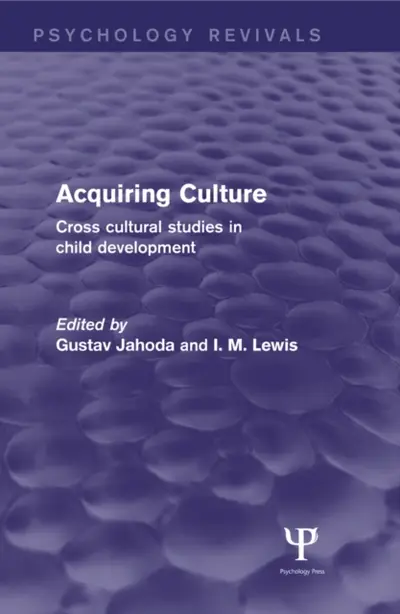
Acquiring Culture
Cross Cultural Studies in Child Development
Price and availability
$78.99
Available in: Andorra, Austria, Australia, Belgium, Bulgaria, Canada, Switzerland, Cyprus, Czechia, Germany, Denmark, Estonia, Spain, Finland, France, United Kingdom, Guernsey, Greece, Croatia, Hungary, Ireland, Isle of Man, Iceland, Italy, Jersey, Japan, Liechtenstein, Lithuania, Luxembourg, Latvia, Monaco, Malta, Netherlands, Norway, Poland, Portugal, Romania, Sweden, Slovenia, Slovakia, San Marino, United States, Vatican City, South Africa
Stores: US, UK, Canada, EU, Australia.
Sign in to buyThe price is re-checked by the server before payment.
For personal use under the eBook licence.
- Format
- DRM
- Not stated by the publisher
- Language
- English
- Publisher
- Taylor & Francis
- Published
- 27 March 2015
- ISBN
- 9781317534402
- Subjects
- Psychology, Child & developmental psychology, Social, group or collective psychology, Social and cultural anthropology, Child, developmental and lifespan psychology
About this book
Until the 70s and 80s anthropologists studying different cultures had mainly confined themselves to the behaviour and idea systems of adults. Psychologists, on the other hand, working mainly in Europe and America, had studied child development in their own settings and simply assumed the universality of their findings. Thus both disciplines had largely ignored a crucial problem area: the way in which children from birth onwards learn to become competent members of their culture. This process, which has been called 'the quintessential human adaptation', constitutes the theme of this volume, originally published in 1988.It derives from a workshop held at the London School of Economics which brought together fieldworkers who in their studies had paid more than usual attention to children in their cultures. Their experience and foci of interest were varied but this very diversity serves to illuminate different facets of the acquisition of culture by children, ranging in age from pre-verbal infants to adolescents. Evolutionarily primed for culture-learning, children are responsive to a rich web of influences from subtle and indirect as in their music and dance to direct teaching in the family guided by culture-specific ideas about child psychology. Some of the salient things they learn relate to gender, status and power, critical for the functioning of all societies.The introductory essay provides the necessary historical background of the development of child study in both anthropology and psychology and outlined how future research in the ethnography of childhood should proceed. The book concludes with an annotated bibliography providing a guide to the literature from 1970 onwards.
Bibliographic data © Gardners Books Ltd.