EPUB · English
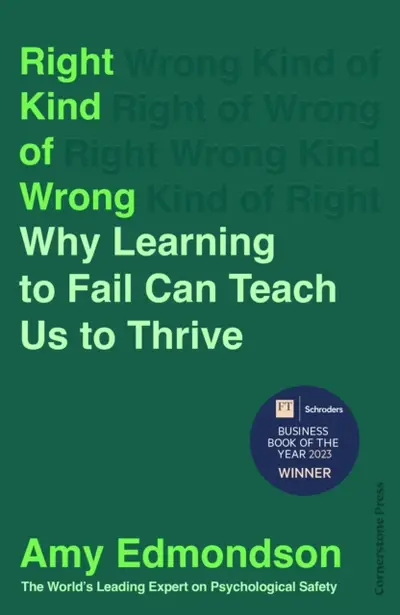
Right Kind of Wrong
Why Learning to Fail Can Teach Us to Thrive
Price and availability
Not sold in this region
Available in: Andorra, Austria, Australia, Belgium, Bulgaria, Switzerland, Cyprus, Czechia, Germany, Denmark, Estonia, Spain, Finland, France, United Kingdom, Guernsey, Greece, Croatia, Hungary, Ireland, Isle of Man, Iceland, Italy, Jersey, Japan, Liechtenstein, Lithuania, Luxembourg, Latvia, Monaco, Malta, Netherlands, Norway, Poland, Portugal, Romania, Sweden, Slovenia, Slovakia, San Marino, Vatican City, South Africa
Stores: UK, EU, Australia. Not available in the United States store.
This title cannot be bought in this store yet: its supplier terms, territorial rights or price are still being confirmed.
For personal use under the eBook licence.
- Format
- EPUB
- DRM
- Not stated by the publisher
- Language
- English
- Publisher
- Cornerstone
- Published
- 7 September 2023
- ISBN
- 9781529160611
- Subjects
- Occupational & industrial psychology, Business strategy, Management: leadership & motivation, Popular psychology, Occupational and industrial psychology, Business strategy, Management: leadership and motivation, Popular psychology
About this book
Winner of the Financial Times Business Book of the Year Award Absolutely outstanding Tim Harford, author of The Undercover Economist'A masterclass Angela Duckworth, author of Grit Excellent Andrew Hill, Financial TimesWe used to think of failure as a problem, to be avoided at all costs. Now, we're often told that failure is desirable - that we must fail fast, fail often . The trouble is, neither approach distinguishes the good failures from the bad. As a result, we miss the opportunity to fail well.Here, Amy Edmondson the world s most influential organisational psychologist reveals how we get failure wrong, and how to get it right. Drawing on four decades of research into the world s most effective teams, she unveils the three archetypes of failure basic, complex and intelligent - and explains how to harness the revolutionary potential of the good ones (and eliminate the bad). Along the way, she poses a simple, provocative question: What if it is only by learning to fail that we can hope to truly succeed? Lays out a clearer path about how to stop avoiding failure and take smarter risks. Books of the Year, Financial Times
Bibliographic data © Gardners Books Ltd.