EPUB · English
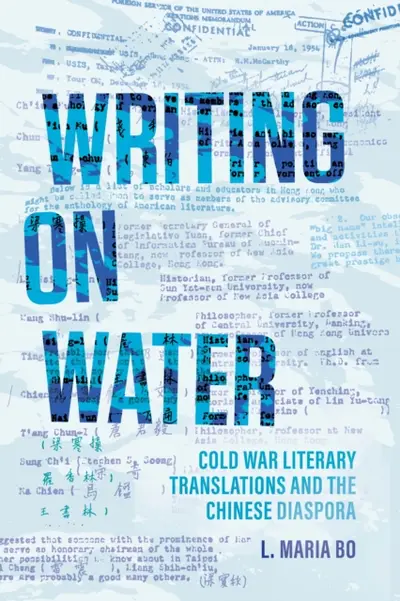
Writing on Water
Cold War Literary Translations and the Chinese Diaspora
Price and availability
$31.99
Not available to buy yet.
Available in: Andorra, Austria, Australia, Belgium, Bulgaria, Canada, Switzerland, Cyprus, Czechia, Germany, Denmark, Estonia, Spain, Finland, France, United Kingdom, Guernsey, Greece, Croatia, Hungary, Ireland, Isle of Man, Iceland, Italy, Jersey, Japan, Liechtenstein, Lithuania, Luxembourg, Latvia, Monaco, Malta, Netherlands, Norway, Poland, Portugal, Romania, Sweden, Slovenia, Slovakia, San Marino, United States, Vatican City, South Africa
Stores: US, UK, Canada, EU, Australia.
This title cannot be bought in this store yet: its supplier terms, territorial rights or price are still being confirmed.
For personal use under the eBook licence.
- Format
- EPUB
- DRM
- Not stated by the publisher
- Language
- English
- Publisher
- Stanford University Press
- Published
- 10 November 2026
- ISBN
- 9781503648470
- Subjects
- USA, 20th century, Literature: history & criticism, Literary studies: general, General & world history, 20th century history: c 1900 to c 2000, Ethnic studies, Black & Asian studies, Literature: history and criticism, Ethnic studies / Ethnicity, General and world history
About this book
During the Cold War, the ideological struggle to win the hearts and minds of the Chinese took place on the pages of literary texts. A battle of the books between Washington D.C. and Beijing mobilized entire networks of U.S. Foreign Service posts, book publishers, and higher education institutions to take sides in propagating representations of either democracy or communism to ethnic Chinese communities around the world. In Writing on Water, L. Maria Bo argues that these propagated literary texts, simply by undergoing translation, also became the means for new forms of anglophone Chinese identity and diasporic communities to emerge. Rather than examining how translated literary texts produced strict equivalents that "e;worked"e; to spread ideology, Bo reads these texts as fluid equivocal exchanges. She attends to the various languages through which these texts traveled, including hegemonic varieties of English, numerous forms of Chinese, and other local patois. Doing so uncovers how ideology and meaning come undone in these texts-in-transit, allowing us imagine the formation of dispersed, ideologically diverse reading publics spanning East Asia, Southeast Asia, and the US heartland.
Bibliographic data © Gardners Books Ltd.