PDF · English
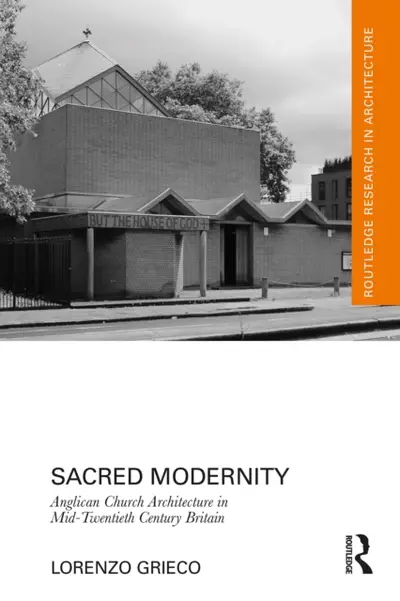
Sacred Modernity
Anglican Church Architecture in Mid-Twentieth Century Britain
Price and availability
$64.99
Available in: Andorra, Austria, Australia, Belgium, Bulgaria, Canada, Switzerland, Cyprus, Czechia, Germany, Denmark, Estonia, Spain, Finland, France, United Kingdom, Guernsey, Greece, Croatia, Hungary, Ireland, Isle of Man, Iceland, Italy, Jersey, Japan, Liechtenstein, Lithuania, Luxembourg, Latvia, Monaco, Malta, Netherlands, Norway, Poland, Portugal, Romania, Sweden, Slovenia, Slovakia, San Marino, United States, Vatican City, South Africa
Stores: US, UK, Canada, EU, Australia.
Sign in to buyThe price is re-checked by the server before payment.
For personal use under the eBook licence.
- Format
- DRM
- Not stated by the publisher
- Language
- English
- Publisher
- Taylor & Francis
- Published
- 30 September 2025
- ISBN
- 9781040435588
- Subjects
- United Kingdom, Great Britain, c 1945 to c 2000 (Post-war period), Theory of architecture, Religious buildings, History of architecture, British & Irish history, Postwar 20th century history, from c 1945 to c 2000, History of religion, Anglican & Episcopalian Churches, Church of England, Conservation of buildings & building materials, Architecture: religious buildings, History of architecture, Anglican and Episcopalian Churches
About this book
This book examines mid-20th-century Anglican church architecture in Britain, from the 1935 to the 1975, exploring how it was shaped by liturgical changes, social shifts, and artistic influences. It investigates the theoretical foundations of modern Anglican church design and the contributions of various denominations to shared worship spaces.Amidst the rise of research groups, publications, and photographic documentation, the book highlights the subject's significance in this period. Inspired by the liturgical reformation within the Church of England, it analyzes churches in their urban contexts and the communities they served, revealing the complex interplay between architects, engineers, artists, local authorities, and clergy.The book also addresses post-war church reconstruction, the adaptation of existing buildings, and the integration of new construction technologies. It explores how churches accommodated secular functions alongside sacred spaces to reduce maintenance costs and foster communal identity. As secularization grew-particularly affecting the Church of England-it also considers the transformation of redundant churches into secular venues.Adopting a cross-disciplinary approach, the book situates Anglican church architecture within broader religious, urban, and social contexts, offering a comprehensive perspective for scholars and practitioners alike.
Bibliographic data © Gardners Books Ltd.