PDF · English
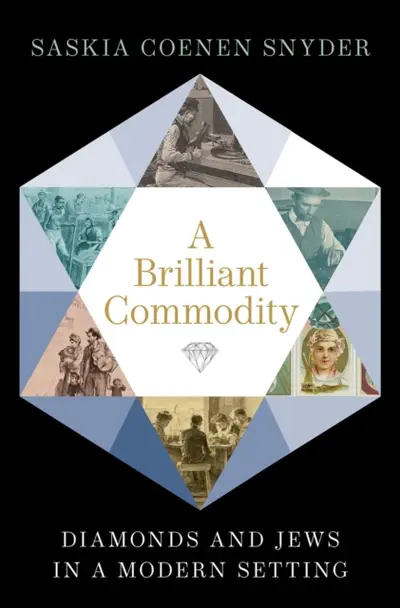
Brilliant Commodity
Diamonds and Jews in a Modern Setting
Price and availability
$25.99
Available in: Andorra, Austria, Australia, Belgium, Bulgaria, Canada, Switzerland, Cyprus, Czechia, Germany, Denmark, Estonia, Spain, Finland, France, United Kingdom, Guernsey, Greece, Croatia, Hungary, Ireland, Isle of Man, Iceland, Italy, Jersey, Japan, Liechtenstein, Lithuania, Luxembourg, Latvia, Monaco, Malta, Netherlands, Norway, Poland, Portugal, Romania, Sweden, Slovenia, Slovakia, San Marino, United States, Vatican City, South Africa
Stores: US, UK, Canada, EU, Australia.
Sign in to buyThe price is re-checked by the server before payment.
For personal use under the eBook licence.
- Format
- DRM
- Not stated by the publisher
- Language
- English
- Publisher
- Oxford University Press
- Published
- 18 January 2022
- ISBN
- 9780197610480
- Subjects
- History of other lands, Social & cultural history, Colonialism & imperialism, Judaism, NHQ, NHTB, NHTQ, QRJ
About this book
Following diamonds from African mines to the necklines of high society women, this international history shows why Jews were central to the transatlantic gem trade and its growth into a global industry. During the late nineteenth century, tens of thousands of diggers, prospectors, merchants, and dealers extracted and shipped over 50 million carats of diamonds from South Africa to London. The primary supplier to the world, South Africa's diamond fields became one of the formative sites of modern capitalist production. At each stage of the diamond's route through the British empire and beyond-from Cape Town to London, from Amsterdam to New York City-carbon gems were primarily mined, processed, appraised, and sold by Jews. In A Brilliant Commodity, historian Saskia Coenen Snyder traces how once-peripheral Jewish populations became the central architects of a new, global exchange of diamonds that connected African sites of supply, European manufacturing centers, American retailers, and western consumers. Centuries of restrictions had limited Jews to trade and finance, businesses that often heavily relied on internal networks. Jews were well-positioned to become key players in the earliest stage of the diamond trade and its growth into a global industry, a development fueled by technological advancements, a dramatic rise in the demand of luxury goods, and an abundance of rough stones. Relying on mercantile and familial ties across continents, Jews created a highly successful commodity chain that included buyers, brokers, cutters, factory owners, financiers, and retailers. Working within a diasporic ethnic community that bridged city and countryside, metropole and colony, Jews helped build a flourishing diamond industry, notably Hatton Garden in London and the Diamond District of New York City, and a place for themselves in the modern world.
Bibliographic data © Gardners Books Ltd.