PDF · English
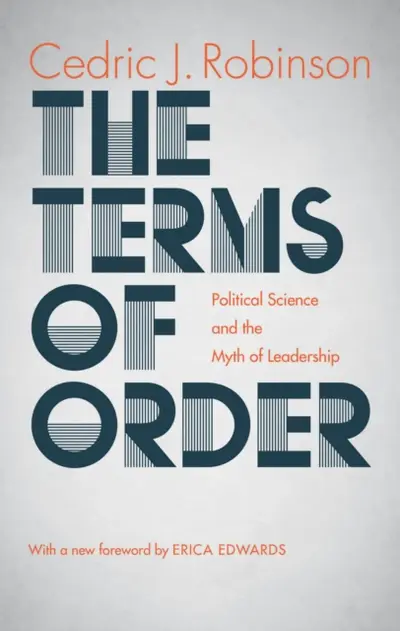
Terms of Order
Political Science and the Myth of Leadership
Price and availability
$77.99
Available in: Andorra, Austria, Australia, Belgium, Bulgaria, Canada, Switzerland, Cyprus, Czechia, Germany, Denmark, Estonia, Spain, Finland, France, United Kingdom, Guernsey, Greece, Croatia, Hungary, Ireland, Isle of Man, Iceland, Italy, Jersey, Japan, Liechtenstein, Lithuania, Luxembourg, Latvia, Monaco, Malta, Netherlands, Norway, Poland, Portugal, Romania, Sweden, Slovenia, Slovakia, San Marino, United States, Vatican City, South Africa
Stores: US, UK, Canada, EU, Australia.
Sign in to buyThe price is re-checked by the server before payment.
For personal use under the eBook licence.
- Format
- DRM
- Not stated by the publisher
- Language
- English
- Publisher
- The University of North Carolina Press
- Published
- 1 April 2016
- ISBN
- 9781469628233
- Subjects
- USA, Ethnic studies, Black & Asian studies, Political structure & processes, Political leaders & leadership, United States of America, USA, JBSL, Political structure and processes, Political leaders and leadership
About this book
Do we live in basically orderly societies that occasionally erupt into violent conflict, or do we fail to perceive the constancy of violence and disorder in our societies? In this classic book, originally published in 1980, Cedric J. Robinson contends that our perception of political order is an illusion, maintained in part by Western political and social theorists who depend on the idea of leadership as a basis for describing and prescribing social order.Using a variety of critical approaches in his analysis, Robinson synthesizes elements of psychoanalysis, structuralism, Marxism, classical and neoclassical political philosophy, and cultural anthropology in order to argue that Western thought on leadership is mythological rather than rational. He then presents examples of historically developed stateless societies with social organizations that suggest conceptual alternatives to the ways political order has been conceived in the West. Examining Western thought from the vantage point of a people only marginally integrated into Western institutions and intellectual traditions, Robinsons perspective radically critiques fundamental ideas of leadership and order.
Bibliographic data © Gardners Books Ltd.