EPUB · English
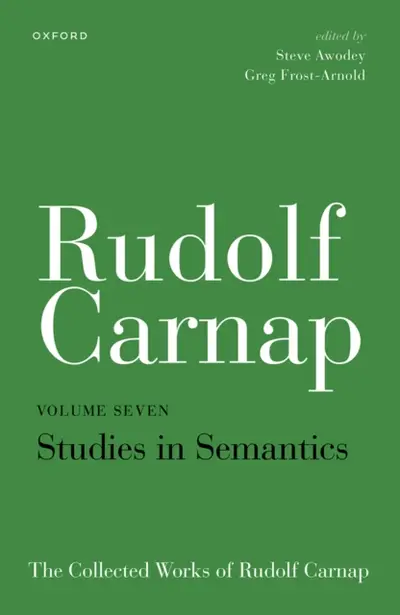
Rudolf Carnap: Studies in Semantics
The Collected Works of Rudolf Carnap, Volume 7
Price and availability
$137.99
Available in: Andorra, Austria, Australia, Belgium, Bulgaria, Canada, Switzerland, Cyprus, Czechia, Germany, Denmark, Estonia, Spain, Finland, France, United Kingdom, Guernsey, Greece, Croatia, Hungary, Ireland, Isle of Man, Iceland, Italy, Jersey, Japan, Liechtenstein, Lithuania, Luxembourg, Latvia, Monaco, Malta, Netherlands, Norway, Poland, Portugal, Romania, Sweden, Slovenia, Slovakia, San Marino, United States, Vatican City, South Africa
Stores: US, UK, Canada, EU, Australia.
Sign in to buyThe price is re-checked by the server before payment.
For personal use under the eBook licence.
- Format
- EPUB
- DRM
- Not stated by the publisher
- Language
- English
- Publisher
- Oxford University Press
- Published
- 22 April 2024
- ISBN
- 9780198907442
- Subjects
- Philosophy of language, Semantics, discourse analysis, etc, Analytical philosophy & Logical Positivism, Philosophy: logic, Philosophy of language, Analytical philosophy and Logical Positivism, Philosophy: logic
About this book
This volume contains Carnap's Studies in Semantics, a series of three interlocking books: Introduction to Semantics (1942), Formalization of Logic (1942), and Meaning and Necessity (1947). They were extremely influential in their time, especially the third, and shaped the direction of analytic philosophy during the 1950s and 1960s. They constitute the background to a number of celebrated controversies of that period, especially those between Carnap and Quine. Most of the philosophical debates today in philosophical logic and the philosophy of language ultimately had their origins here. This new edition situates these works in their context, both within Carnap's philosophical development and within the philosophical debates they responded to and influenced. The editors' introduction explains how Carnap arrived at the project of semantics in the 1930s and how it developed into these three successive publications, how the three books fit together, and how the project developed and changed in the course of the 1940s. It also describes the reception of the books as they appeared, as well as Carnap's response. The editorial and textual notes give variant readings, Carnap's own marginal notes on these texts in his personal copies, and elucidatory commentary where Carnap's terminology or notation are no longer familiar. This will be an indispensable volume for anyone interested in the origins and preoccupations of present-day analytic philosophy, especially philosophical logic and philosophy of language.
Bibliographic data © Gardners Books Ltd.