EPUB · English
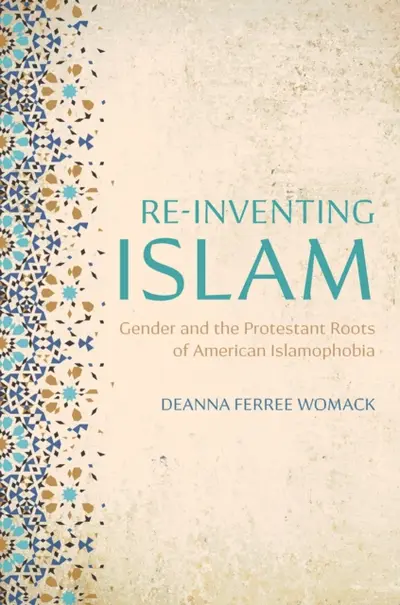
Re-inventing Islam
Gender and the Protestant Roots of American Islamophobia
Price and availability
$79.99
Available in: Andorra, Austria, Australia, Belgium, Bulgaria, Canada, Switzerland, Cyprus, Czechia, Germany, Denmark, Estonia, Spain, Finland, France, United Kingdom, Guernsey, Greece, Croatia, Hungary, Ireland, Isle of Man, Iceland, Italy, Jersey, Japan, Liechtenstein, Lithuania, Luxembourg, Latvia, Monaco, Malta, Netherlands, Norway, Poland, Portugal, Romania, Sweden, Slovenia, Slovakia, San Marino, United States, Vatican City, South Africa
Stores: US, UK, Canada, EU, Australia.
Sign in to buyThe price is re-checked by the server before payment.
For personal use under the eBook licence.
- Format
- EPUB
- DRM
- Not stated by the publisher
- Language
- English
- Publisher
- Oxford University Press
- Published
- 9 May 2025
- ISBN
- 9780197699171
- Subjects
- Interfaith relations, History of religion, Christianity, Church history, Islam, QRAF, QRAX, QRM, QRP
About this book
From the end of the American Civil War to the start of World War II, the Protestant missionary movement unintentionally tilled the soil in which American Islamophobia would eventually take root. What ideas did missionaries in Islamic contexts pass on to later generations? How were these ideas connected to centuries-old Protestant discourses about Muslims and gender beginning in the Reformation? And what bearing does this history have on the birth of Islamophobia and on Christian-Muslim dialogue efforts in the US today? In answering these questions, Re-inventing Islam traces the gender constructs that have informed historical Protestant perceptions of Islam, especially in the far-reaching textual, visual, and material influences of the American and British movement for missions to Muslims. This book first considers Protestant discourse about Muslim women and men from the Reformation to the Enlightenment. Then it turns to the colossal archive of literature, images, and cultural objects that missionaries--and particularly missionary women--collected from Islamic contexts and used to inform and motivate their constituents. Anglo-Protestants in the nineteenth and early twentieth centuries perpetually re-invented stereotypes about Muslims and used these negative images to achieve particular Protestant theological and political purposes, including missionary aims. They did so when disseminating gender critiques widely to Protestant men, women, and children. Why did they re-invent Islam? Deanna Ferree Womack argues that they did so to reinforce Protestant theological claims, to justify their evangelistic endeavors, to express both humanitarian concern and Eurocentric views of the world, and to support British and American cultural, economic, and military expansion. Simultaneously, however, this same missionary movement educated its constituents about diverse Islamic cultures, in part by providing humanizing images of Islam. Missionaries also formed personal relationships with Muslims that would open pathways toward formal efforts of Christian-Muslim dialogue after the mid-twentieth century. Americans have inherited all of these legacies. In revisiting this history readers will find new possibilities for building a more open and just future.
Bibliographic data © Gardners Books Ltd.