EPUB · English
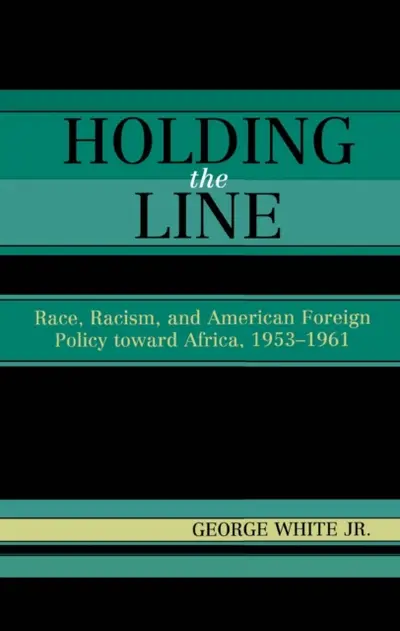
Holding the Line
Race, Racism, and American Foreign Policy Toward Africa, 1953-1961
Price and availability
$133.99
Available in: Andorra, Austria, Australia, Belgium, Bulgaria, Canada, Switzerland, Cyprus, Czechia, Germany, Denmark, Estonia, Spain, Finland, France, United Kingdom, Guernsey, Greece, Croatia, Hungary, Ireland, Isle of Man, Iceland, Italy, Jersey, Japan, Liechtenstein, Lithuania, Luxembourg, Latvia, Monaco, Malta, Netherlands, Norway, Poland, Portugal, Romania, Sweden, Slovenia, Slovakia, San Marino, United States, Vatican City, South Africa
Stores: US, UK, Canada, EU, Australia.
Sign in to buyThe price is re-checked by the server before payment.
For personal use under the eBook licence.
- Format
- EPUB
- DRM
- Not stated by the publisher
- Language
- English
- Publisher
- Bloomsbury Publishing (USA)
- Published
- 4 November 2005
- Pages
- 240
- ISBN
- 9781461637363
- Subjects
- Politics & government, International relations, Diplomacy, Politics and government, International relations, Diplomacy
About this book
The rivalry between the United States and the Soviet Union intensified as Dwight D. Eisenhower entered the White House. However, the burning question for the vast majority of the world's population was not whether they would join the 'Free World' or the Soviet bloc, but whether they could achieve meaningful self-determination. Nowhere did the answer to that question loom larger than in Africa. The Eisenhower administration's confrontation with Africa demonstrates the significance of race in the creation and execution of American foreign policy. In this new work, historian George White, Jr. explores the ways in which Eisenhower diplomacy, influenced by America's racialized fantasies, fears, and desires, turned the Cold War into a global sanctuary for the rehabilitation of Whiteness. In turn, American statesmen and bureaucrats justified the undermining of democracy and freedom by stuffing the multi-faceted realities of African aspirations and Western privileges into the straitjacket of a bi-polar worldview. Using as its foundation American relations with Ethiopia, Ghana, South Africa, and the Congo, Holding the Line demonstrates the power of race to warp perception and to severely limit the parameters and possibilities of human engagement. Holding the Line provides a fresh perspective on 1950s era U.S. foreign relations that remain salient in American diplomacy today. This is a book that will be of interest to students of American diplomatic history, Critical Race and Whiteness studies, American studies, and international relations.
Bibliographic data © Gardners Books Ltd.