PDF · English
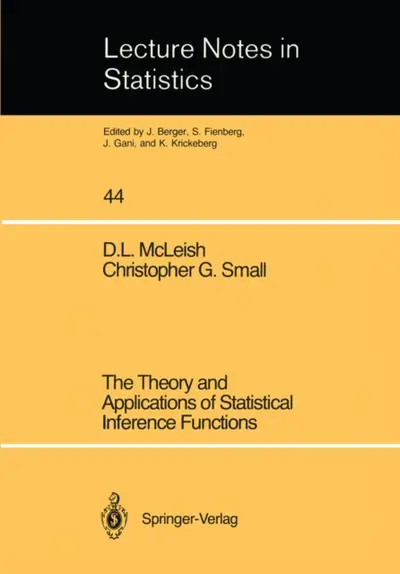
Theory and Applications of Statistical Interference Functions
Price and availability
$60.99
Available in: Andorra, Austria, Australia, Belgium, Bulgaria, Canada, Switzerland, Cyprus, Czechia, Germany, Denmark, Estonia, Spain, Finland, France, United Kingdom, Guernsey, Greece, Croatia, Hungary, Ireland, Isle of Man, Iceland, Italy, Jersey, Japan, Liechtenstein, Lithuania, Luxembourg, Latvia, Monaco, Malta, Netherlands, Norway, Poland, Portugal, Romania, Sweden, Slovenia, Slovakia, San Marino, United States, Vatican City, South Africa
Stores: US, UK, Canada, EU, Australia.
Sign in to buyThe price is re-checked by the server before payment.
For personal use under the eBook licence.
- Format
- DRM
- Not stated by the publisher
- Language
- English
- Publisher
- Springer New York
- Published
- 6 December 2012
- ISBN
- 9781461238720
- Subjects
- Applied mathematics, Applied mathematics
About this book
This monograph arose out of a desire to develop an approach to statistical infer- ence that would be both comprehensive in its treatment of statistical principles and sufficiently powerful to be applicable to a variety of important practical problems. In the latter category, the problems of inference for stochastic processes (which arise com- monly in engineering and biological applications) come to mind. Classes of estimating functions seem to be promising in this respect. The monograph examines some of the consequences of extending standard concepts of ancillarity, sufficiency and complete- ness into this setting. The reader should note that the development is mathematically "e;mature"e; in its use of Hilbert space methods but not, we believe, mathematically difficult. This is in keeping with our desire to construct a theory that is rich in statistical tools for infer- ence without the difficulties found in modern developments, such as likelihood analysis of stochastic processes or higher order methods, to name but two. The fundamental notions of orthogonality and projection are accessible to a good undergraduate or beginning graduate student. We hope that the monograph will serve the purpose of enriching the methods available to statisticians of various interests.
Bibliographic data © Gardners Books Ltd.