PDF · English
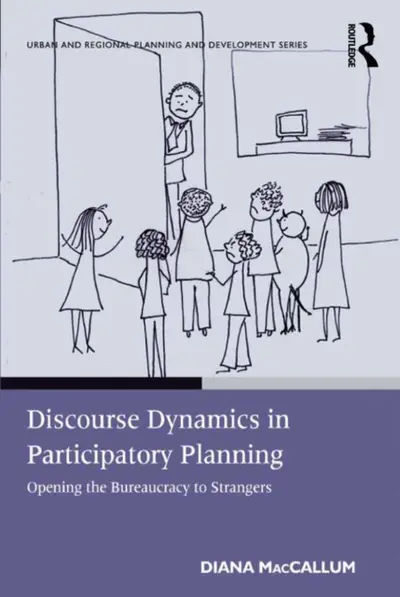
Discourse Dynamics in Participatory Planning
Opening the Bureaucracy to Strangers
Price and availability
$78.99
Available in: Andorra, Austria, Australia, Belgium, Bulgaria, Canada, Switzerland, Cyprus, Czechia, Germany, Denmark, Estonia, Spain, Finland, France, United Kingdom, Guernsey, Greece, Croatia, Hungary, Ireland, Isle of Man, Iceland, Italy, Jersey, Japan, Liechtenstein, Lithuania, Luxembourg, Latvia, Monaco, Malta, Netherlands, Norway, Poland, Portugal, Romania, Sweden, Slovenia, Slovakia, San Marino, United States, Vatican City, South Africa
Stores: US, UK, Canada, EU, Australia.
Sign in to buyThe price is re-checked by the server before payment.
For personal use under the eBook licence.
- Format
- DRM
- Not stated by the publisher
- Language
- English
- Publisher
- Taylor & Francis
- Published
- 23 May 2016
- ISBN
- 9781317149897
- Subjects
- Urban communities, Regional & area planning, Urban & municipal planning, Australia, Research methods / methodology, Social research and statistics, Public administration / Public policy
About this book
This book introduces the methodology of critical discourse analysis (CDA) to the study of participatory planning. CDA uses linguistic analysis to elucidate social issues and processes and is particularly suited to institutional practices and how they are changing in response to changing social conditions. Illustrated by two case studies from Australia, it examines the talk between the various participants in a formal stakeholder committee context over five years, during which time they went through several phases of changing power dynamics, conflict and reconciliation. The book demonstrates the value of CDA to this field of research and develops specific techniques and conceptual tools for applying the methodology to the 'formal talk' context of collaborative planning committees. It also sheds light on the dynamics of interaction between 'stakeholders' and bureaucracies - particularly with respect to inherent communicative barriers, power inequalities, and the development of new discursive practices.
Bibliographic data © Gardners Books Ltd.