PDF · English
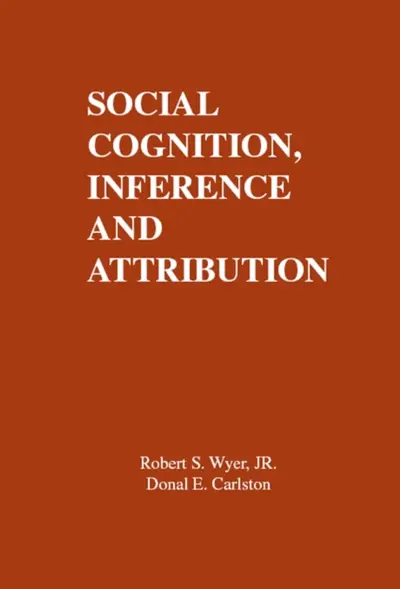
Social Cognition, Inference, and Attribution
Price and availability
$79.99
Available in: Andorra, Austria, Australia, Belgium, Bulgaria, Canada, Switzerland, Cyprus, Czechia, Germany, Denmark, Estonia, Spain, Finland, France, United Kingdom, Guernsey, Greece, Croatia, Hungary, Ireland, Isle of Man, Iceland, Italy, Jersey, Japan, Liechtenstein, Lithuania, Luxembourg, Latvia, Monaco, Malta, Netherlands, Norway, Poland, Portugal, Romania, Sweden, Slovenia, Slovakia, San Marino, United States, Vatican City, South Africa
Stores: US, UK, Canada, EU, Australia.
Sign in to buyThe price is re-checked by the server before payment.
For personal use under the eBook licence.
- Format
- DRM
- Not stated by the publisher
- Language
- English
- Publisher
- Taylor & Francis
- Published
- 7 December 2018
- ISBN
- 9781134925544
- Subjects
- Psychology, Social, group or collective psychology, Cognition & cognitive psychology, The self, ego, identity, personality, Social, group or collective psychology, Cognition and cognitive psychology, Psychology: the self, ego, identity, personality
About this book
First published in 1979.This book developed out of a series of general discussions between the authors on research and theory in person perception and attribution phenomena. During the course of this discussion, two things became clear. First, many of the traditional approaches to investigating these phenomena, made popular during the past decade by the advent of algebraic models of information integration, were not providing answers to several fundamental questions concerning the manner in which social stimulus information is interpreted, organized, and stored in memory, and the factors that affect its retrieval and use in making judgments of the people and events to which it is relevant. Second, many fundamental issues associated with the processing of social stimulus information were relevant to phenomena investigated in a variety of traditionally segregated areas (e.g., impression formation, attribution, social comparison, interpersonal attraction, belief and opinion change, etc.). However, these commonalities were rarely identified. This appeared to result from a tendency to focus on micro-theoretical formulations developed to account for a circumscribed set of phenomena, without considering these phenomena within a broader conceptual framework. This book is an attempt to respond to these various deficiencies.
Bibliographic data © Gardners Books Ltd.