EPUB · English
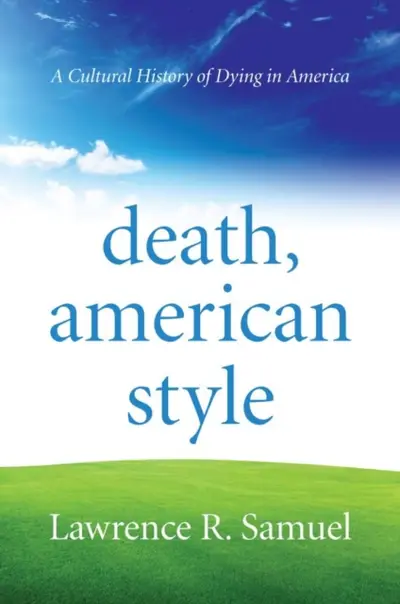
Death, American Style
A Cultural History of Dying in America
Price and availability
$38.99
Available in: Andorra, Austria, Australia, Belgium, Bulgaria, Canada, Switzerland, Cyprus, Czechia, Germany, Denmark, Estonia, Spain, Finland, France, United Kingdom, Guernsey, Greece, Croatia, Hungary, Ireland, Isle of Man, Iceland, Italy, Jersey, Japan, Liechtenstein, Lithuania, Luxembourg, Latvia, Monaco, Malta, Netherlands, Norway, Poland, Portugal, Romania, Sweden, Slovenia, Slovakia, San Marino, United States, Vatican City, South Africa
Stores: US, UK, Canada, EU, Australia.
Sign in to buyThe price is re-checked by the server before payment.
For personal use under the eBook licence.
- Format
- EPUB
- DRM
- Not stated by the publisher
- Language
- English
- Publisher
- Bloomsbury Publishing (USA)
- Published
- 5 July 2013
- Pages
- 212
- ISBN
- 9781442222243
- Subjects
- USA, General & world history, Popular culture, Sociology: death & dying, Social, group or collective psychology, United States of America, USA, JBCC1, Sociology: death and dying, Social, group or collective psychology, NHB
About this book
The notion of one day disappearing from the earth forever is contrary to many of America's defining cultural values, with death and dying viewed as "e;un-American"e; experiences. Arguing that death and dying may be our last major taboo, this book shows how death and dying became almost unmentionable words over the course of the last century. Although we have recently made some progress in reconciling the fact that life is a finite resource, we remain very unprepared for the approaching tsunami of death as the largest generation in history begins to age and die in great numbers. DEATH, AMERICAN STYLE is thus highly timely and relevant, suggesting that Americans need to individually and collectively come to terms with mortality if we are to learn to treat death as an inevitable part of life, and to prepare accordingly. As more and more Americans face end of life decisions, it will be vital for us to radically change the current view of death and dying. The alternative, the author argues, is that the emerging "e;death-centric"e; society may bring with it a period of turmoil equivalent to that of the countercultural 1960s and 1970s.
Bibliographic data © Gardners Books Ltd.