EPUB · English
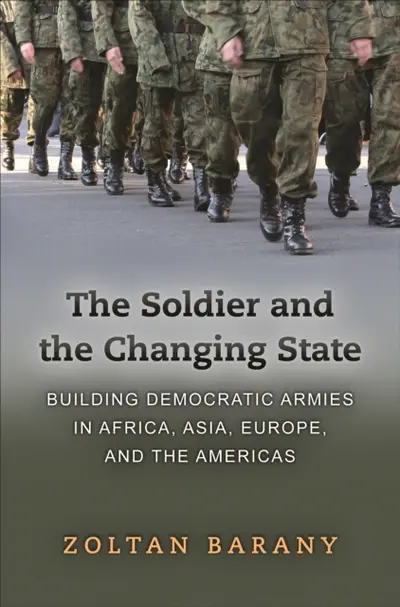
Soldier and the Changing State
Building Democratic Armies in Africa, Asia, Europe, and the Americas
Price and availability
$56.99
Available in: Andorra, Austria, Australia, Belgium, Bulgaria, Canada, Switzerland, Cyprus, Czechia, Germany, Denmark, Estonia, Spain, Finland, France, United Kingdom, Guernsey, Greece, Croatia, Hungary, Ireland, Isle of Man, Iceland, Italy, Jersey, Japan, Liechtenstein, Lithuania, Luxembourg, Latvia, Monaco, Malta, Netherlands, Norway, Poland, Portugal, Romania, Sweden, Slovenia, Slovakia, San Marino, United States, Vatican City, South Africa
Stores: US, UK, Canada, EU, Australia.
Sign in to buyThe price is re-checked by the server before payment.
For personal use under the eBook licence.
- Format
- EPUB
- DRM
- Not stated by the publisher
- Language
- English
- Publisher
- Princeton University Press
- Published
- 16 September 2012
- ISBN
- 9781400845491
- Subjects
- Military history, Globalization, Political structure & processes, Political structures: democracy, International relations, Warfare & defence, Globalization, Politics and government, Political structures / systems: democracy, International relations, Military history
About this book
The Soldier and the Changing State is the first book to systematically explore, on a global scale, civil-military relations in democratizing and changing states. Looking at how armies supportive of democracy are built, Zoltan Barany argues that the military is the most important institution that states maintain, for without military elites who support democratic governance, democracy cannot be consolidated. Barany also demonstrates that building democratic armies is the quintessential task of newly democratizing regimes. But how do democratic armies come about? What conditions encourage or impede democratic civil-military relations? And how can the state ensure the allegiance of its soldiers? Barany examines the experiences of developing countries and the armed forces in the context of major political change in six specific settings: in the wake of war and civil war, after military and communist regimes, and following colonialism and unification/apartheid. He evaluates the army-building and democratization experiences of twenty-seven countries and explains which predemocratic settings are most conducive to creating a military that will support democracy. Highlighting important factors and suggesting which reforms can be expected to work and fail in different environments, he offers practical policy recommendations to state-builders and democratizers.
Bibliographic data © Gardners Books Ltd.