PDF · English
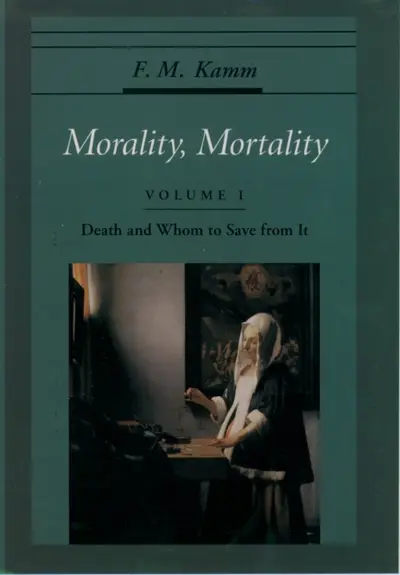
Morality, Mortality
Volume I: Death and Whom to Save from It
Price and availability
$39.99
Available in: Andorra, Austria, Australia, Belgium, Bulgaria, Canada, Switzerland, Cyprus, Czechia, Germany, Denmark, Estonia, Spain, Finland, France, United Kingdom, Guernsey, Greece, Croatia, Hungary, Ireland, Isle of Man, Iceland, Italy, Jersey, Japan, Liechtenstein, Lithuania, Luxembourg, Latvia, Monaco, Malta, Netherlands, Norway, Poland, Portugal, Romania, Sweden, Slovenia, Slovakia, San Marino, United States, Vatican City, South Africa
Stores: US, UK, Canada, EU, Australia.
Sign in to buyThe price is re-checked by the server before payment.
For personal use under the eBook licence.
- Format
- DRM
- Not stated by the publisher
- Language
- English
- Publisher
- Oxford University Press
- Published
- 7 May 1998
- ISBN
- 9780198024019
- Subjects
- Ethics & moral philosophy, Sociology: death & dying, Medical ethics & professional conduct, Sociology: death and dying, Medical ethics and professional conduct, QDTQ
About this book
Why is death bad for us, even on the assumption that it involves the absence of experience? Is it worse for us than prenatal nonexistence? Kamm begins by considering these questions, critically examining some answers other philosophers have given. She explores in detail suggestions based on our greater concern over the loss of future versus past goods and those based on the insult to persons which death involves. In the second part, Kamm deals with the question, "e;Whom should we save from death if we cannot save everyone?"e; She considers whether and when the numbers of lives we can save matter in our choice, and whether the extra good we achieve if we save some lives rather than others should play a role in deciding whom to save. Issues such as fairness, solidarity, the role of random decision procedures, and the relation between subjective and objective points of view are discussed, with an eye to properly incorporating these into a nonconsequentialist ethical theory. In conclusion, the book examines specifically what differences between persons are relevant to the distribution of any scarce resource, discussing for example, the distribution (and acquisition) of bodily organs for transplantation. Kamm provides criticism of some current procedures for distribution and acquisition of a scarce resource and makes suggestions for alternatives.
Bibliographic data © Gardners Books Ltd.