PDF · English
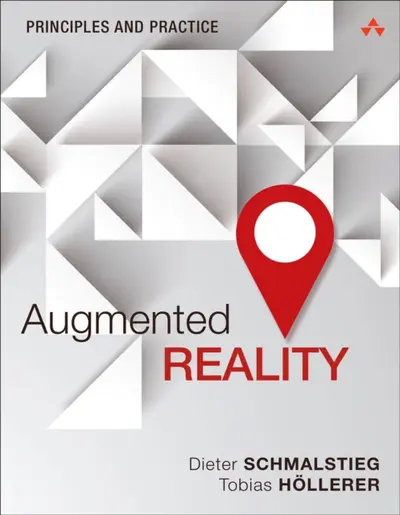
Augmented Reality
Principles and Practice
Price and availability
$44.99
Available in: Andorra, Austria, Australia, Belgium, Bulgaria, Canada, Switzerland, Cyprus, Czechia, Germany, Denmark, Estonia, Spain, Finland, France, United Kingdom, Guernsey, Greece, Croatia, Hungary, Ireland, Isle of Man, Iceland, Italy, Jersey, Japan, Liechtenstein, Lithuania, Luxembourg, Latvia, Monaco, Malta, Netherlands, Norway, Poland, Portugal, Romania, Sweden, Slovenia, Slovakia, San Marino, United States, Vatican City, South Africa
Stores: US, UK, Canada, EU, Australia.
Sign in to buyThe price is re-checked by the server before payment.
For personal use under the eBook licence.
- Format
- DRM
- Not stated by the publisher
- Language
- English
- Publisher
- Pearson Education
- Published
- 1 June 2016
- Pages
- 528
- ISBN
- 9780133153231
- Subjects
- Virtual reality, Human-computer interaction, Virtual worlds
About this book
Today's Comprehensive and Authoritative Guide to Augmented Reality By overlaying computer-generated information on the real world, augmented reality (AR) amplifies human perception and cognition in remarkable ways. Working in this fast-growing field requires knowledge of multiple disciplines, including computer vision, computer graphics, and human-computer interaction. Augmented Reality: Principles and Practice integrates all this knowledge into a single-source reference, presenting today's most significant work with scrupulous accuracy. Pioneering researchers Dieter Schmalstieg and Tobias Hollerer carefully balance principles and practice, illuminating AR from technical, methodological, and user perspectives. Coverage includes Displays: head-mounted, handheld, projective, auditory, and haptic Tracking/sensing, including physical principles, sensor fusion, and real-time computer vision Calibration/registration, ensuring repeatable, accurate, coherent behavior Seamless blending of real and virtual objects Visualization to enhance intuitive understanding Interaction-from situated browsing to full 3D interaction Modeling new geometric content Authoring AR presentations and databases Architecting AR systems with real-time, multimedia, and distributed elements This guide is indispensable for anyone interested in AR, including developers, engineers, students, instructors, researchers, and serious hobbyists.
Bibliographic data © Gardners Books Ltd.