EPUB · English
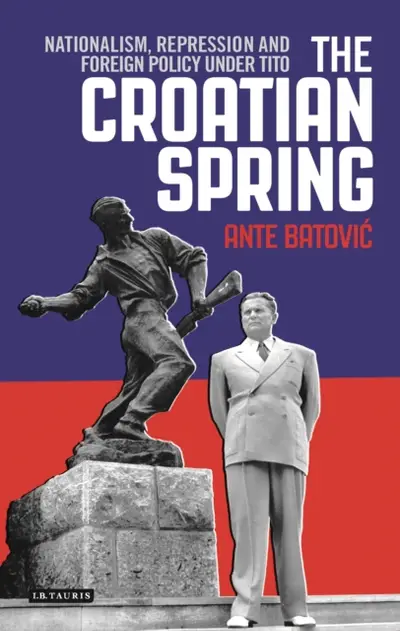
Croatian Spring
Nationalism, Repression and Foreign Policy Under Tito
Price and availability
$42.99
Available in: Andorra, Austria, Australia, Belgium, Bulgaria, Canada, Switzerland, Cyprus, Czechia, Germany, Denmark, Estonia, Spain, Finland, France, United Kingdom, Guernsey, Greece, Croatia, Hungary, Ireland, Isle of Man, Iceland, Italy, Jersey, Japan, Liechtenstein, Lithuania, Luxembourg, Latvia, Monaco, Malta, Netherlands, Norway, Poland, Portugal, Romania, Sweden, Slovenia, Slovakia, San Marino, United States, Vatican City, South Africa
Stores: US, UK, Canada, EU, Australia.
Sign in to buyThe price is re-checked by the server before payment.
For personal use under the eBook licence.
- Format
- EPUB
- DRM
- Not stated by the publisher
- Language
- English
- Publisher
- Bloomsbury Publishing
- Published
- 30 June 2017
- Pages
- 368
- ISBN
- 9781786721846
- Subjects
- Eastern Europe, Croatia, c 1945 to c 2000 (Post-war period), European history, Revolutions, uprisings, rebellions, Marxism & Communism, Nationalism, Political leaders & leadership, 3MPQ, Far-left political ideologies and movements, Nationalism and nationalist ideologies and movements, Political leaders and leadership, NHD, NHTV
About this book
Nationalism is a key topic within Balkan Studies, and one of the driving forces behind the bloody and difficult history of the region. Using primary sources not previously utilized by western scholars, this book documents the 'Croatian Spring' - a national and liberal movement that began in the mid-sixties after the fall of the vice president and head of the Yugoslav secret police Aleksandar Rankovic. The author chronicles these developments of democratisation and de-centralisation of communist Yugoslavia, placing them in the wider context of the Cold War and Yugoslav relations with the Soviet Union and the UnitedStates. Tito managed to balance national stability and his relations with East and West, until he felt that the national-liberal movements challenged his authority, and thus threaten the very foundations of the Yugoslav state. From late 1971 onwards, the liberal political and cultural classes of Croatia and other republics were abruptly purged, impoverishing Yugoslav leadership for subsequent decades.Batovic also considers the role of the West, who felt a centralised and stable Yugoslavia was in their interests and quickly accommodated themselves to the repression of the reformist movement.
Bibliographic data © Gardners Books Ltd.