EPUB · English
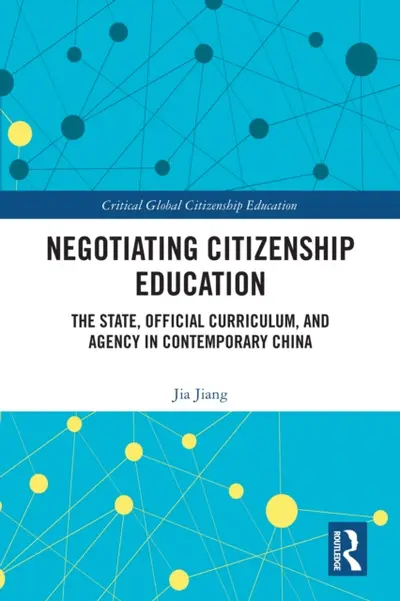
Negotiating Citizenship Education
The State, Official Curriculum, and Agency in Contemporary China
Price and availability
$64.99
Available in: Andorra, Austria, Australia, Belgium, Bulgaria, Canada, Switzerland, Cyprus, Czechia, Germany, Denmark, Estonia, Spain, Finland, France, United Kingdom, Guernsey, Greece, Croatia, Hungary, Ireland, Isle of Man, Iceland, Italy, Jersey, Japan, Liechtenstein, Lithuania, Luxembourg, Latvia, Monaco, Malta, Netherlands, Norway, Poland, Portugal, Romania, Sweden, Slovenia, Slovakia, San Marino, United States, Vatican City, South Africa
Stores: US, UK, Canada, EU, Australia.
Sign in to buyThe price is re-checked by the server before payment.
For personal use under the eBook licence.
- Format
- EPUB
- DRM
- Not stated by the publisher
- Language
- English
- Publisher
- Taylor & Francis
- Published
- 20 February 2026
- ISBN
- 9781040631966
- Subjects
- Central Asia, China, Regional studies, Sociology, Education, Moral & social purpose of education, Secondary schools, Teaching of a specific subject, Political science & theory, China, Educational strategies and policy, Civics and citizenship
About this book
Negotiating Citizenship Education (CE) explores the dynamics, tensions, and space in Chinese socialist CE, focusing on how the political, economic, social, and educational structures in China, as well as individual agency, shape CE curriculum, teaching, and learning.In contrast to the West, China, as a party-state, has been promoting socialist CE for regime support since the Chinese Communist Party (CCP) took over the leadership in 1949. However, this version of CE has been challenged by China's economic development, individualization of society, and globalization. This volume traces the historical changes of the Party-state-defined citizenship and CE curriculum in response to social changes. Importantly, drawing upon a qualitative study setting in two high schools in a relatively liberal province in China, it vividly documents how Chinese teachers and students negotiate with official CE discourse in their classroom teaching and learning through a new comprehensive theoretical framework of social structure and agency. Ultimately, it advocates for a reconstruction of the CE curriculum, educational system, and civic environment to cultivate agentic citizens.This book will be a beneficial read for scholars, academics, and students in the fields of international and comparative education, sociology of education, CE, China studies, and citizenship studies.
Bibliographic data © Gardners Books Ltd.