EPUB · English
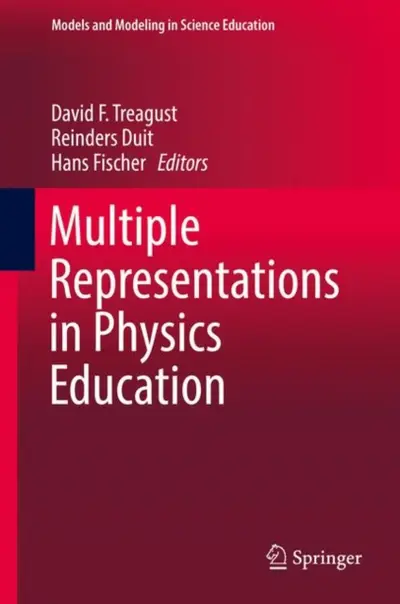
Multiple Representations in Physics Education
Price and availability
$175.99
Available in: Andorra, Austria, Australia, Belgium, Bulgaria, Canada, Switzerland, Cyprus, Czechia, Germany, Denmark, Estonia, Spain, Finland, France, United Kingdom, Guernsey, Greece, Croatia, Hungary, Ireland, Isle of Man, Iceland, Italy, Jersey, Japan, Liechtenstein, Lithuania, Luxembourg, Latvia, Monaco, Malta, Netherlands, Norway, Poland, Portugal, Romania, Sweden, Slovenia, Slovakia, San Marino, United States, Vatican City, South Africa
Stores: US, UK, Canada, EU, Australia.
Sign in to buyThe price is re-checked by the server before payment.
For personal use under the eBook licence.
- Format
- EPUB
- DRM
- Not stated by the publisher
- Language
- English
- Publisher
- Springer International Publishing
- Published
- 24 July 2017
- ISBN
- 9783319589145
- Subjects
- Educational psychology, Higher & further education, tertiary education, Teacher training, Teaching of a specific subject, Study & learning skills: general, Science: general issues, Educational psychology, Higher education, tertiary education, Teacher training, Teaching of a specific subject, Study and learning skills: general, Science: general issues
About this book
This volume is important because despite various external representations, such as analogies, metaphors, and visualizations being commonly used by physics teachers, educators and researchers, the notion of using the pedagogical functions of multiple representations to support teaching and learning is still a gap in physics education. The research presented in the three sections of the book is introduced by descriptions of various psychological theories that are applied in different ways for designing physics teaching and learning in classroom settings. The following chapters of the book illustrate teaching and learning with respect to applying specific physics multiple representations in different levels of the education system and in different physics topics using analogies and models, different modes, and in reasoning and representational competence. When multiple representations are used in physics for teaching, the expectation is that they should be successful. To ensure this is the case, the implementation of representations should consider design principles for using multiple representations. Investigations regarding their effect on classroom communication as well as on the learning results in all levels of schooling and for different topics of physics are reported. The book is intended for physics educators and their students at universities and for physics teachers in schools to apply multiple representations in physics in a productive way.
Bibliographic data © Gardners Books Ltd.