EPUB · English
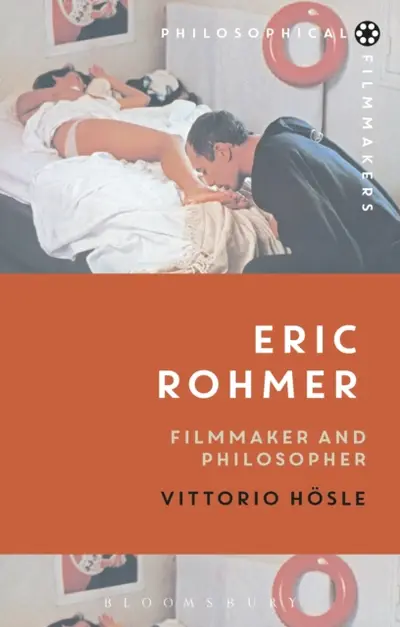
Eric Rohmer
Filmmaker and Philosopher
Price and availability
$30.99
Available in: Andorra, Austria, Australia, Belgium, Bulgaria, Canada, Switzerland, Cyprus, Czechia, Germany, Denmark, Estonia, Spain, Finland, France, United Kingdom, Guernsey, Greece, Croatia, Hungary, Ireland, Isle of Man, Iceland, Italy, Jersey, Japan, Liechtenstein, Lithuania, Luxembourg, Latvia, Monaco, Malta, Netherlands, Norway, Poland, Portugal, Romania, Sweden, Slovenia, Slovakia, San Marino, United States, Vatican City, South Africa
Stores: US, UK, Canada, EU, Australia.
Sign in to buyThe price is re-checked by the server before payment.
For personal use under the eBook licence.
- Format
- EPUB
- DRM
- Not stated by the publisher
- Language
- English
- Publisher
- Bloomsbury Publishing
- Published
- 28 July 2016
- Pages
- 216
- ISBN
- 9781474221153
- Subjects
- Film theory & criticism, Individual film directors, film-makers, Western philosophy, from c 1900 -, Philosophy: aesthetics, ATFA, ATFB, QDHR, QDTN
About this book
Rohmer is one of the most popular French directors of the second half of the 20th century, one of the members of the famous Nouvelle Vague that reconstituted French cinema based on the theoretical principles articulated in the Cahiers du Cin ma from whose editorship he was fired when the conservative Catholic opposed its turn toward politicization. Like some of his colleagues, Rohmer is extremely interested in both the history and the philosophy of film: Brother of the noted French philosopher Ren Scherer, he begins his career as a film critic In his films, deep moral conflicts as well as the search for one's own identity emerge from the intricacies of seemingly superficial everyday life interactions, particularly between a man and a woman. H sle's book puts Rohmer in the context of a long French tradition of reflected eroticism, with Marivaux, Musset, Stendhal, and Jean Renoir as crucial figures, and shows how Rohmer both recognizes the inner logic of eroticism and subjects it to moral demands that he inherits from his Catholic background. For Rohmer, the tension between the two can usually only be solved by some unexpected event that can be interpreted as an equivalent of grace.
Bibliographic data © Gardners Books Ltd.