EPUB · English
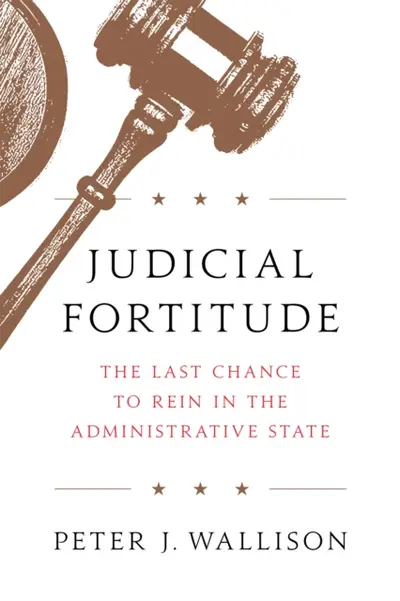
Judicial Fortitude
The Last Chance to Rein In the Administrative State
Price and availability
$32.99
Available in: Andorra, Austria, Australia, Belgium, Bulgaria, Canada, Switzerland, Cyprus, Czechia, Germany, Denmark, Estonia, Spain, Finland, France, United Kingdom, Guernsey, Greece, Croatia, Hungary, Ireland, Isle of Man, Iceland, Italy, Jersey, Japan, Liechtenstein, Lithuania, Luxembourg, Latvia, Monaco, Malta, Netherlands, Norway, Poland, Portugal, Romania, Sweden, Slovenia, Slovakia, San Marino, United States, Vatican City, South Africa
Stores: US, UK, Canada, EU, Australia.
Sign in to buyThe price is re-checked by the server before payment.
For personal use under the eBook licence.
- Format
- EPUB
- DRM
- Not stated by the publisher
- Language
- English
- Publisher
- Encounter Books
- Published
- 16 October 2018
- ISBN
- 9781641770095
- Subjects
- Political structure & processes, Constitution: government & the state, Constitutional & administrative law, Government powers, Judicial review, Political structure and processes, Constitution: government and the state, Constitutional and administrative law: general, Government powers, Judicial review
About this book
In this book, Peter J. Wallison argues that the administrative agencies of the executive branch have gradually taken over the legislative role of Congress, resulting in what many call the administrative state. The judiciary bears the major responsibility for this development because it has failed to carry out its primary constitutional responsibility: to enforce the constitutional separation of powers by ensuring that the elected branches of governmentthe legislative and the executiveremain independent and separate from one another. Since 1937, and especially with the Chevron deference adopted by the Supreme Court in 1984, the judiciary has abandoned this role. It has allowed Congress to delegate lawmaking authorities to the administrative agencies of the executive branch and given these agencies great latitude in interpreting their statutory authorities. Unelected officials of the administrative state have thus been enabled to make decisions for the American people that, in a democracy, should only be made by Congress. The consequences have been grave: unnecessary regulation has imposed major costs on the U.S. economy, the constitutional separation of powers has been compromised, and unabated agency rulemaking has created a significant threat that Americans will one day question the legitimacy of their own government. To address these concerns, Wallison argues that the courts must return to the role the Framers expected them to fulfill.
Bibliographic data © Gardners Books Ltd.