EPUB · English
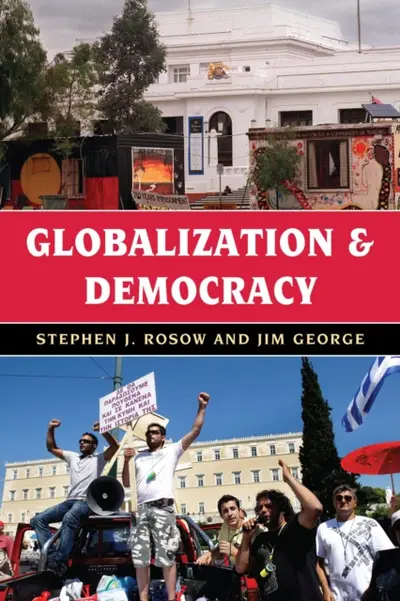
Globalization and Democracy
Price and availability
$43.99
Available in: Andorra, Austria, Australia, Belgium, Bulgaria, Canada, Switzerland, Cyprus, Czechia, Germany, Denmark, Estonia, Spain, Finland, France, United Kingdom, Guernsey, Greece, Croatia, Hungary, Ireland, Isle of Man, Iceland, Italy, Jersey, Japan, Liechtenstein, Lithuania, Luxembourg, Latvia, Monaco, Malta, Netherlands, Norway, Poland, Portugal, Romania, Sweden, Slovenia, Slovakia, San Marino, United States, Vatican City, South Africa
Stores: US, UK, Canada, EU, Australia.
Sign in to buyThe price is re-checked by the server before payment.
For personal use under the eBook licence.
- Format
- EPUB
- DRM
- Not stated by the publisher
- Language
- English
- Publisher
- Bloomsbury Publishing (USA)
- Published
- 22 July 2014
- Pages
- 218
- ISBN
- 9781442218109
- Subjects
- Globalization, Political science & theory, Political structures: democracy, International relations, GTQ, Political science and theory, Political structures / systems: democracy, International relations
About this book
Combining theory with compelling case studies, this book examines the globalizing world of democracy. Noted critical scholars Stephen J. Rosow and Jim George argue that democracy must be understood not as a unified concept but as a diversity of political responses to specific conditions and political struggles. Doing so reveals how democracy is taking multiple forms around the world in response to neoliberal globalism and the increasing pace and complexity of everyday life. The authors show how the current phase of globalization is destabilizing the dominance of Western democracy promotion as resisters challenge common understandings and forms of democracy. Explaining the theory behind neoliberal globalization and democracy promotion, they consider its impact and struggles against it in South Africa, post-Soviet Russia, India, and Venezuela and other "e;pink tide"e; states in Latin America. Rosow and George also examine how digital communications networks, the centralization of security, and the fluid movements of people and ideas are destabilizing traditional democratic theories. At the same time, they give rise to concepts of democracy that focus on new forms of citizenship and democratic participation, a cosmopolitan democratic constitutionalism, cross-boundary political activism, and local and community-based economic and democratic practices.
Bibliographic data © Gardners Books Ltd.