EPUB · English
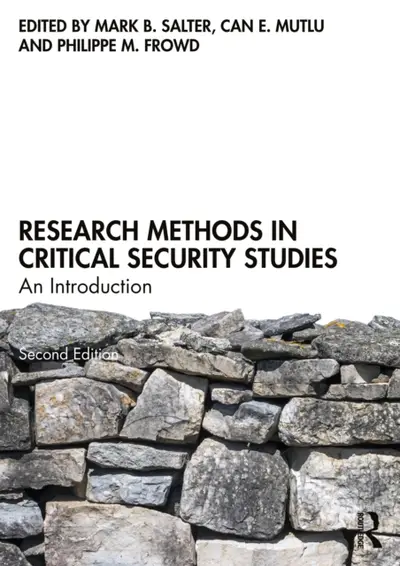
Research Methods in Critical Security Studies
An Introduction
Price and availability
$51.99
Available in: Andorra, Austria, Australia, Belgium, Bulgaria, Canada, Switzerland, Cyprus, Czechia, Germany, Denmark, Estonia, Spain, Finland, France, United Kingdom, Guernsey, Greece, Croatia, Hungary, Ireland, Isle of Man, Iceland, Italy, Jersey, Japan, Liechtenstein, Lithuania, Luxembourg, Latvia, Monaco, Malta, Netherlands, Norway, Poland, Portugal, Romania, Sweden, Slovenia, Slovakia, San Marino, United States, Vatican City, South Africa
Stores: US, UK, Canada, EU, Australia.
Sign in to buyThe price is re-checked by the server before payment.
For personal use under the eBook licence.
- Format
- EPUB
- DRM
- Not stated by the publisher
- Language
- English
- Publisher
- Taylor & Francis
- Published
- 12 May 2023
- ISBN
- 9781000863499
- Subjects
- Peace studies & conflict resolution, Social research & statistics, Armed conflict, Warfare & defence, Research methods / methodology, International relations
About this book
This textbook surveys new and emergent methods for doing research in critical security studies, filling a gap in the literature. The second edition has been revised and updated. This textbook is a practical guide to research design in this increasingly established field. Arguing for serious attention to questions of research design and method, the book develops accessible scholarly overviews of key methods used across critical security studies, such as ethnography, discourse analysis, materiality, and corporeal methods. It draws on prominent examples of each method's objects of analysis, relevant data, and forms of data collection. The book's defining feature is the collection of diverse accounts of research design from scholars working within each method, each of which is a clear and honest recounting of a specific project's design and development. This second edition is extensively revised and expanded. Its 33 contributors reflect the sheer diversity of critical security studies today, representing various career stages, scholarly interests, and identities. This book is systematic in its approach to research design but keeps a reflexive and pluralist approach to the question of methods and how they can be used. The second edition has a new forward-looking conclusion examining future research trends and challenges for the field. This book will be essential reading for upper-level students and researchers in the field of critical security studies, and of much interest to students in International Relations and across the social sciences.
Bibliographic data © Gardners Books Ltd.