PDF · English
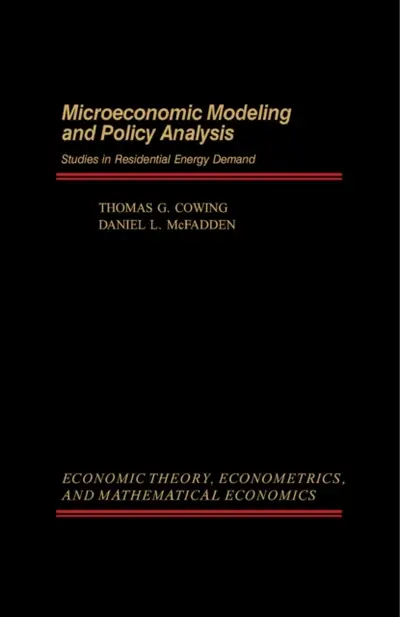
Microeconomic Modeling and Policy Analysis
Studies in Residential Energy Demand
Price and availability
$59.99
Available in: Andorra, Austria, Australia, Belgium, Bulgaria, Canada, Switzerland, Cyprus, Czechia, Germany, Denmark, Estonia, Spain, Finland, France, United Kingdom, Guernsey, Greece, Croatia, Hungary, Ireland, Isle of Man, Iceland, Italy, Jersey, Japan, Liechtenstein, Lithuania, Luxembourg, Latvia, Monaco, Malta, Netherlands, Norway, Poland, Portugal, Romania, Sweden, Slovenia, Slovakia, San Marino, United States, Vatican City, South Africa
Stores: US, UK, Canada, EU, Australia.
Sign in to buyThe price is re-checked by the server before payment.
For personal use under the eBook licence.
- Format
- DRM
- Not stated by the publisher
- Language
- English
- Publisher
- Elsevier Science
- Published
- 22 October 2013
- ISBN
- 9781483268491
- Subjects
- Anthropology, Property & real estate, Anthropology, Property and real estate
About this book
Microeconomic Modeling and Policy Analysis: Studies in Residential Energy Demand analyzes the aggregates and distributional impacts from alternative energy polices related to the energy demands of residential consumers. The book also analyzes the use of micro-simulation models in the study. The book examines three alternative energy policies and their possible impacts on the residential energy demand. The text describes models on energy use including general micro-simulation and micro-simulation as applied in "e;"e;Residential End-Use Energy Planning Systems"e;"e; (REEPS) and the Oak Ridge National Laboratory (ORNL) Residential Energy Consumption Model. The book describes REEPS as a model providing end-use specific forecasts of energy consumption at the household level. The text describes ORNL as a computationally simpler design but conceptually more complex one. The book then evaluates three different policy scenarios using each of these two models. The performance of REEPS and ORNL, as well as other dimensions of model projections, is examined. The implications regarding 1) policy analysis and 2) the use of micro simulation models are noted. The book then presents a table that summarizes the results of the comparative model evaluation. Energy policymakers, city and local government planning officials, development engineers, and environmentalists will find this book very relevant.
Bibliographic data © Gardners Books Ltd.