EPUB · English
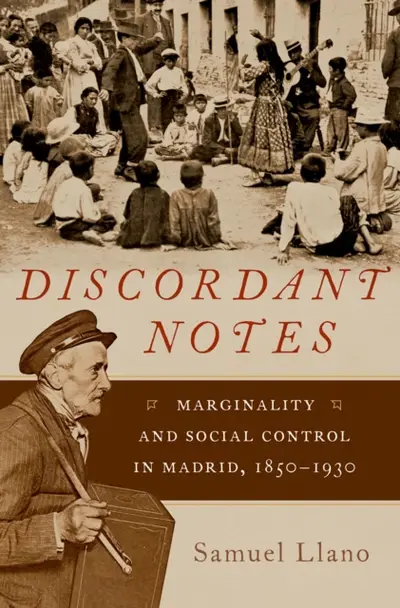
Discordant Notes
Marginality and Social Control in Madrid, 1850-1930
Price and availability
$45.99
Available in: Andorra, Austria, Australia, Belgium, Bulgaria, Canada, Switzerland, Cyprus, Czechia, Germany, Denmark, Estonia, Spain, Finland, France, United Kingdom, Guernsey, Greece, Croatia, Hungary, Ireland, Isle of Man, Iceland, Italy, Jersey, Japan, Liechtenstein, Lithuania, Luxembourg, Latvia, Monaco, Malta, Netherlands, Norway, Poland, Portugal, Romania, Sweden, Slovenia, Slovakia, San Marino, United States, Vatican City, South Africa
Stores: US, UK, Canada, EU, Australia.
Sign in to buyThe price is re-checked by the server before payment.
For personal use under the eBook licence.
- Format
- EPUB
- DRM
- Not stated by the publisher
- Language
- English
- Publisher
- Oxford University Press
- Published
- 31 October 2018
- ISBN
- 9780190916367
- Subjects
- Spain, c 1800 to c 1900, 20th century, Music, Theory of music & musicology, European history, Social & cultural history, 3MN, 3MP, Music, Theory of music and musicology, NHD, NHTB
About this book
Scholarship on urban culture and the senses has traditionally focused on the study of literature and the visual arts. Recent decades have seen a surge of interest on the effects of sound the urban space and its population. These studies analyse how sound generates identities that are often fragmentary and mutually conflicting. They also explore the ways in which sound triggers campaigns against the negative effects of noise on the nerves and health of the population. Little research has been carried out about the impact of sound and music in areas of broader social and political concern such as social aid, hygiene and social control. Based on a detailed study of Madrid from the 1850s to the 1930s, Discordant Notes argues that sound and music have played a key role in structuring the transition to modernity by helping to negotiate social attitudes and legal responses to problems such as poverty, insalubrity, and crime. Attempts to control the social groups that own unwanted musical practices such as organ grinding and flamenco performances in taverns raised awareness about public hygiene, alcoholism and crime, and triggered legal reform in these areas. In addition to scapegoating, marginalising and persecuting these musical practices, the authorities and the media used workhouse bands as instruments of social control to spread "e;aural hygiene"e; across the city.
Bibliographic data © Gardners Books Ltd.