PDF · German
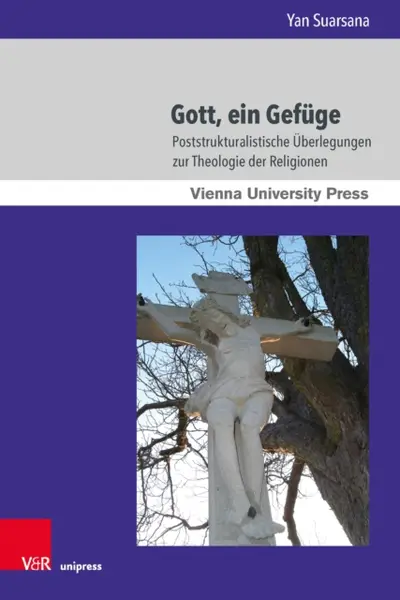
Gott, ein Gefüge
Poststrukturalistische Überlegungen zur Theologie der Religionen
Price and availability
$54.99
Available in: Andorra, Austria, Australia, Belgium, Bulgaria, Canada, Switzerland, Cyprus, Czechia, Germany, Denmark, Estonia, Spain, Finland, France, United Kingdom, Guernsey, Greece, Croatia, Hungary, Ireland, Isle of Man, Iceland, Italy, Jersey, Japan, Liechtenstein, Lithuania, Luxembourg, Latvia, Monaco, Malta, Netherlands, Norway, Poland, Portugal, Romania, Sweden, Slovenia, Slovakia, San Marino, United States, Vatican City, South Africa
Stores: US, UK, Canada, EU, Australia.
Sign in to buyThe price is re-checked by the server before payment.
For personal use under the eBook licence.
- Format
- DRM
- Not stated by the publisher
- Language
- German
- Publisher
- Brill Deutschland GmbH
- Published
- 15 November 2021
- ISBN
- 9783847013358
- Subjects
- Comparative religion, Interfaith relations, Comparative religion, Interfaith relations
About this book
Die durch die poststrukturalistische und postkoloniale Theorie geprägten Debatten um den globalen Religionsbegriff, wie sie aktuell in der Religionswissenschaft geführt werden, haben zum Teil auch in der Theologie zu einer Neureflexion althergebrachter Konzepte geführt. Der vorliegende Band hat zum Ziel, diese Debatten zu bündeln und für die Theologie der Religionen fruchtbar zu machen. Dabei werden zum einen zentrale Kategorien wie Wahrheit, Universalität oder Religion einer Dekonstruktion unterzogen, um diese in ihrer historischen Bedingtheit sowie ihrer Verflechtung mit gesellschaftlichen Diskursen sichtbar zu machen. Zum anderen werden neue Räume des Sagbaren skizziert, die als Grundlage einer alternativen, nicht-essentialistischen Form religionstheologischen Sprechens dienen können.This book extends the contemporary debate on the global concept of religion, conducted in the context of religious studies, to the field of the theology of religions. In applying poststructuralist and postcolonial perspectives, it seeks to deconstruct central categories such as truth, universality, or religion, in order to contextualize them by making transparent their historical genealogy and entanglement with political, social, and scientific discourses. Further, it aims to outline new areas of thinking, which can serve as the experimental basis of an alternative, non-essentialist form of theology (of religions).
Bibliographic data © Gardners Books Ltd.