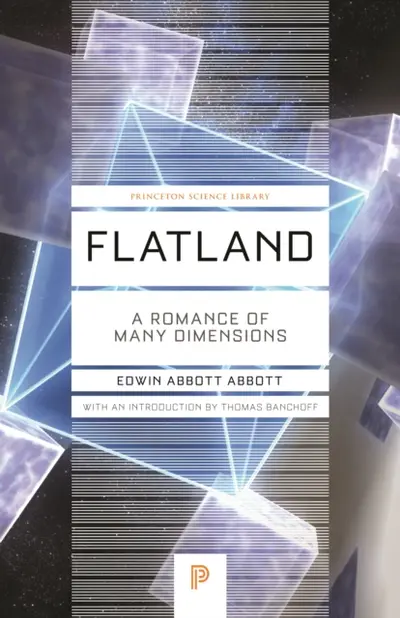
EPUB · English
Flatland
A Romance of Many Dimensions
Price and availability
$17.99
Available in: Andorra, Austria, Australia, Belgium, Bulgaria, Canada, Switzerland, Cyprus, Czechia, Germany, Denmark, Estonia, Spain, Finland, France, United Kingdom, Guernsey, Greece, Croatia, Hungary, Ireland, Isle of Man, Iceland, Italy, Jersey, Japan, Liechtenstein, Lithuania, Luxembourg, Latvia, Monaco, Malta, Netherlands, Norway, Poland, Portugal, Romania, Sweden, Slovenia, Slovakia, San Marino, United States, Vatican City, South Africa
Stores: US, UK, Canada, EU, Australia.
Sign in to buyThe price is re-checked by the server before payment.
For personal use under the eBook licence.
- Format
- EPUB
- DRM
- Not stated by the publisher
- Language
- English
- Publisher
- Princeton University Press
- Published
- 22 March 2015
- ISBN
- 9781400866649
- Subjects
- English, Classic fiction (pre c 1945), Science fiction, Popular mathematics, Relativity physics, Fiction: literary and general non-genre, Science fiction, Satirical fiction and parodies, Mathematics, Geometry, Popular and recreational mathematics, Graphical and digital media applications, Sudoku and number puzzles
About this book
In 1884, Edwin Abbott Abbott wrote a mathematical adventure set in a two-dimensional plane world, populated by a hierarchical society of regular geometrical figures-who think and speak and have all too human emotions. Since then Flatland has fascinated generations of readers, becoming a perennial science-fiction favorite. By imagining the contact of beings from different dimensions, the author fully exploited the power of the analogy between the limitations of humans and those of his two-dimensional characters. A first-rate fictional guide to the concept of multiple dimensions of space, the book will also appeal to those who are interested in computer graphics. This field, which literally makes higher dimensions seeable, has aroused a new interest in visualization. We can now manipulate objects in four dimensions and observe their three-dimensional slices tumbling on the computer screen. But how do we interpret these images? In his introduction, Thomas Banchoff points out that there is no better way to begin exploring the problem of understanding higher-dimensional slicing phenomena than reading this classic novel of the Victorian era.
Bibliographic data © Gardners Books Ltd.