PDF · English
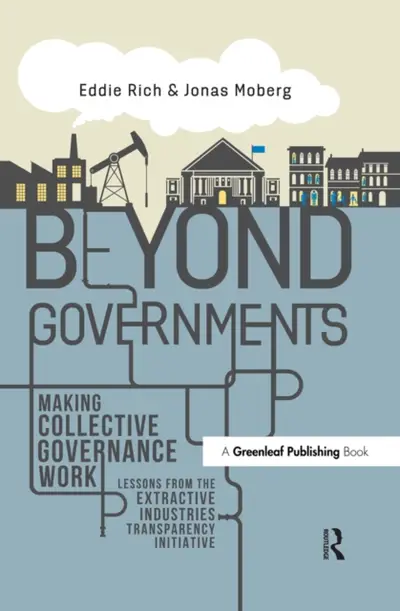
Beyond Governments
Making Collective Governance Work - Lessons from the Extractive Industries Transparency Initiative
Price and availability
$51.99
Available in: Andorra, Austria, Australia, Belgium, Bulgaria, Canada, Switzerland, Cyprus, Czechia, Germany, Denmark, Estonia, Spain, Finland, France, United Kingdom, Guernsey, Greece, Croatia, Hungary, Ireland, Isle of Man, Iceland, Italy, Jersey, Japan, Liechtenstein, Lithuania, Luxembourg, Latvia, Monaco, Malta, Netherlands, Norway, Poland, Portugal, Romania, Sweden, Slovenia, Slovakia, San Marino, United States, Vatican City, South Africa
Stores: US, UK, Canada, EU, Australia.
Sign in to buyThe price is re-checked by the server before payment.
For personal use under the eBook licence.
- Format
- DRM
- Not stated by the publisher
- Language
- English
- Publisher
- Taylor & Francis
- Published
- 8 September 2017
- ISBN
- 9781351286077
- Subjects
- Business ethics & social responsibility, Corporate governance, Public administration / Public policy, Corruption in politics, government and society, Petroleum, oil and gas industries
About this book
In a world characterized by globalization, governments increasingly find themselves unable to govern. Corruption is everywhere, natural resources are being exploited, the environment damaged, markets distorted, and the fight against poverty is often ineffective. Certain challenges cannot be addressed by governments alone. Increasingly, collective governance "e;beyond governments"e; is seen as part of the solution, with state and non-state actors working together.This book sets out a framework for those wishing to implement collective governance, involving civil society, companies and governments as key actors. Based on over eight years of running the most advanced example of collective governance at international level, the Head and Deputy Head of the Extractive Industries Transparency Initiative (EITI) outline the practicalities and pitfalls, and draw out the experience of the EITI as a case example.Beyond Governments tells a positive story of how this type of innovative governance can make real achievements, but also cautions against those who see collective governance as a silver bullet to solve development challenges. It provides practical guidance from a practitioner's perspective and is essential reading for those in government, business and academia.
Bibliographic data © Gardners Books Ltd.