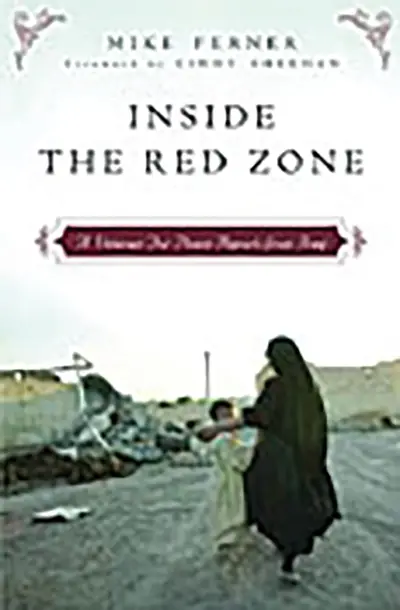
PDF · English
Inside the Red Zone
A Veteran For Peace Reports from Iraq
Price and availability
$72.99
Available in: Andorra, Austria, Australia, Belgium, Bulgaria, Canada, Switzerland, Cyprus, Czechia, Germany, Denmark, Estonia, Spain, Finland, France, United Kingdom, Guernsey, Greece, Croatia, Hungary, Ireland, Isle of Man, Iceland, Italy, Jersey, Japan, Liechtenstein, Lithuania, Luxembourg, Latvia, Monaco, Malta, Netherlands, Norway, Poland, Portugal, Romania, Sweden, Slovenia, Slovakia, San Marino, United States, Vatican City, South Africa
Stores: US, UK, Canada, EU, Australia.
Sign in to buyThe price is re-checked by the server before payment.
For personal use under the eBook licence.
- Format
- DRM
- Not stated by the publisher
- Language
- English
- Publisher
- Bloomsbury Publishing (USA)
- Published
- 30 September 2006
- Pages
- 184
- ISBN
- 9780313084744
- Subjects
- Iraq, Peace studies & conflict resolution, Politics & government, GTU, Politics and government
About this book
Mike Ferner, a peace activist and journalist from Ohio, traveled to Baghdad twice, once just before the U.S. invasion in March 2003 and once again a year later. In this book, he profiles Cliff Kindy of the Christian Peacemaker Teams; Kathy Kelly of Voices in the Wilderness; and other peace activists, soldiers, journalists, and ordinary Iraqis he met during his two extended visits to what became known as the Red Zone, the area outside the protected Green Zone enclave. He provides a rare inside look into the daily life of Iraqis before and after the war as well as a collective profile of segments of the contemporary American peace movement that have thus far been hidden from public view.These stories have been gathered on the dusty streets of Baghdad and from tiny farming villages in the Sunni Triangle. They were not collected from the lobby of a five-star hotel, nor from behind the tinted windows of an armored SUV. We meet activists who are unarmed, trained civilians who put their bodies in between rival factions to promote peace, sitting in front of tanks and bulldozers and fasting in the desert on the Iraq-Kuwait border shortly before 130,000 U.S. troops invaded in 2003. We also are given an unvarnished view of everyday people in Iraq-cab drivers, an unemployed engineer, a newspaper editor, farmers in a rural village-all living their lives as normally as possible in the cauldron their country has become. The humanity of the people in these stories will resonate with people of all political persuasions because they go beyond the portrayal of Iraqis we're used to seeing in the news-as casualties, victims, grieving parents, and shell-shocked children. Instead, when Ferner gave presentations upon his return from Iraq, the comment he most often heard was, These people are just like us. They're just like people we know.
Bibliographic data © Gardners Books Ltd.