PDF · English
Monte Carlo Method in Condensed Matter Physics
Price and availability
$97.99
Available in: Andorra, Austria, Australia, Belgium, Bulgaria, Canada, Switzerland, Cyprus, Czechia, Germany, Denmark, Estonia, Spain, Finland, France, United Kingdom, Guernsey, Greece, Croatia, Hungary, Ireland, Isle of Man, Iceland, Italy, Jersey, Japan, Liechtenstein, Lithuania, Luxembourg, Latvia, Monaco, Malta, Netherlands, Norway, Poland, Portugal, Romania, Sweden, Slovenia, Slovakia, San Marino, United States, Vatican City, South Africa
Stores: US, UK, Canada, EU, Australia.
Sign in to buyThe price is re-checked by the server before payment.
For personal use under the eBook licence.
- Format
- DRM
- Not stated by the publisher
- Language
- English
- Publisher
- Springer Berlin Heidelberg
- Published
- 6 December 2012
- ISBN
- 9783662028551
- Subjects
- Condensed matter physics (liquid state & solid state physics), Mathematical physics, Condensed matter physics (liquid state and solid state physics), Mathematical / Computational / Theoretical physics
About this book
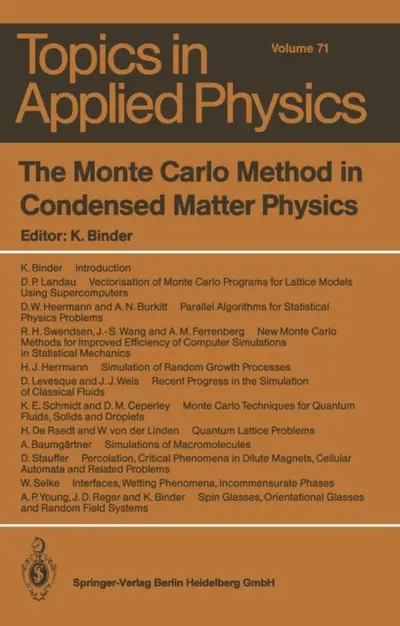
The Monte Carlo method is now widely used and commonly accepted as an important and useful tool in solid state physics and related fields. It is broadly recognized that the technique of "e;computer simulation"e; is complementary to both analytical theory and experiment, and can significantly contribute to ad- vancing the understanding of various scientific problems. Widespread applications of the Monte Carlo method to various fields of the statistical mechanics of condensed matter physics have already been reviewed in two previously published books, namely Monte Carlo Methods in Statistical Physics (Topics Curro Phys. , Vol. 7, 1st edn. 1979, 2ndedn. 1986) and Applications of the Monte Carlo Method in Statistical Physics (Topics Curro Phys. , Vol. 36, 1st edn. 1984, 2nd edn. 1987). Meanwhile the field has continued its rapid growth and expansion, and applications to new fields have appeared that were not treated at all in the above two books (e. g. studies of irreversible growth phenomena, cellular automata, interfaces, and quantum problems on lattices). Also, new methodic aspects have emerged, such as aspects of efficient use of vector com- puters or parallel computers, more efficient analysis of simulated systems con- figurations, and methods to reduce critical slowing down at i>hase transitions. Taken together with the extensive activity in certain traditional areas of research (simulation of classical and quantum fluids, of macromolecular materials, of spin glasses and quadrupolar glasses, etc.
Bibliographic data © Gardners Books Ltd.