PDF · English
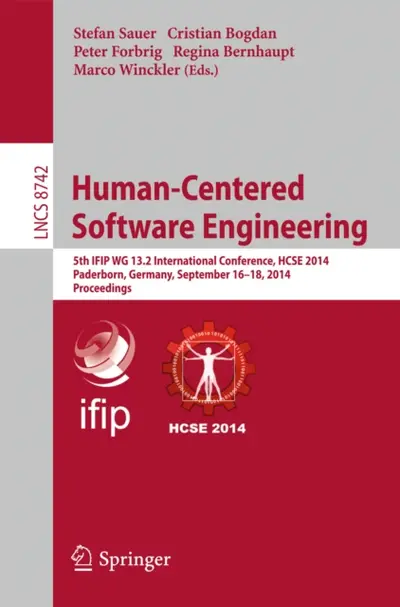
Human-Centered Software Engineering
5th IFIP WG 13.2 International Conference, HCSE 2014, Paderborn, Germany, September 16-18, 2014. Proceedings
Price and availability
$60.99
Available in: Andorra, Austria, Australia, Belgium, Bulgaria, Canada, Switzerland, Cyprus, Czechia, Germany, Denmark, Estonia, Spain, Finland, France, United Kingdom, Guernsey, Greece, Croatia, Hungary, Ireland, Isle of Man, Iceland, Italy, Jersey, Japan, Liechtenstein, Lithuania, Luxembourg, Latvia, Monaco, Malta, Netherlands, Norway, Poland, Portugal, Romania, Sweden, Slovenia, Slovakia, San Marino, United States, Vatican City, South Africa
Stores: US, UK, Canada, EU, Australia.
Sign in to buyThe price is re-checked by the server before payment.
For personal use under the eBook licence.
- Format
- DRM
- Not stated by the publisher
- Language
- English
- Publisher
- Springer Berlin Heidelberg
- Published
- 2 September 2014
- ISBN
- 9783662448113
- Subjects
- Information technology: general issues, Ethical & social aspects of IT, Business applications, Network hardware, Software Engineering, Computer networking & communications, Artificial intelligence, Human-computer interaction, User interface design & usability, Digital and information technologies: social and ethical aspects, Network hardware, Software Engineering, Applied computing, Artificial intelligence (AI), Human–computer interaction
About this book
This book constitutes the refereed proceedings of the 5th IFIP WG 13.2 International Conference on Human-Centered Software Engineering, HCSE 2014, held in Paderborn, Germany, in September 2014. The 13 full papers and 10 short papers presented together with one keynote were carefully reviewed and selected from 35 submissions. The papers cover various topics such as integration of software engineering and user-centered design; HCI models and model-driven engineering; incorporating guidelines and principles for designing usable products in the development process; usability engineering; methods for user interface design; patterns in HCI and HCSE; software architectures for user interfaces; user interfaces for special environments; representations for design in the development process; working with iterative and agile process models in HCSE; social and organizational aspects in the software development lifecycle; human-centric software development tools; user profiles and mental models; user requirements and design constraints; and user experience and software design.
Bibliographic data © Gardners Books Ltd.