PDF · English
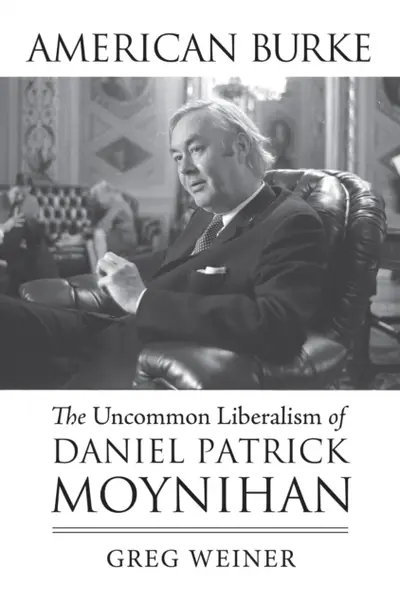
American Burke
The Uncommon Liberalism of Daniel Patrick Moynihan
Price and availability
$31.99
Available in: Andorra, Austria, Australia, Belgium, Bulgaria, Canada, Switzerland, Cyprus, Czechia, Germany, Denmark, Estonia, Spain, Finland, France, United Kingdom, Guernsey, Greece, Croatia, Hungary, Ireland, Isle of Man, Iceland, Italy, Jersey, Japan, Liechtenstein, Lithuania, Luxembourg, Latvia, Monaco, Malta, Netherlands, Norway, Poland, Portugal, Romania, Sweden, Slovenia, Slovakia, San Marino, United States, Vatican City, South Africa
Stores: US, UK, Canada, EU, Australia.
Sign in to buyThe price is re-checked by the server before payment.
For personal use under the eBook licence.
- Format
- DRM
- Not stated by the publisher
- Language
- English
- Publisher
- University Press of Kansas
- Published
- 23 March 2015
- ISBN
- 9780700620975
- Subjects
- USA, c 1945 to c 2000 (Post-war period), Autobiography: historical, political & military, Political science & theory, Liberalism & centre democratic ideologies, Political structures: democracy, Biography: historical, political and military, Right-of-centre democratic ideologies and movements, Political structures / systems: democracy
About this book
Daniel Patrick Moynihan (19272003) may be best known as a statesman. He served in the administrations of presidents Kennedy, Johnson, Nixon, and Ford; was ambassador to India and the United Nations; and represented New York in the U.S. Senate for four terms. But he was also an intellectual of the first order, whose books and papers on topics ranging from welfare policy and ethnicity in American society to international law stirred debate and steered policy. Moynihan was, journalist Michael Barone remarked, the nations best thinker among politicians since Lincoln and its best politician among thinkers since Jefferson. He was, Greg Weiner argues, Americas answer to the 18th-century Anglo-Irish scholar-statesman Edmund Burke. Both stood at the intersection of thought and action, denouncing tyranny, defending the family, championing reform. Yet while Burke is typically claimed by conservatives, Weiner calls Moynihan a Burkean liberal who respected both the indispensability of government and the complexity of society. And a reclamation of Moynihans Burkean liberalism, Weiner suggests, could do wonders for the polarized politics of our day. In its incisive analysis of Moynihans political thought, American Burke lays out the terms for such a recovery. The book traces Moynihans development through the broad sweep of his writings and career. The central conservative truth is that it is culture, not politics, that determines the success of a society, Moynihan once wrote. The central liberal truth is that politics can change a culture and save it from itself. In his ability to embrace both of these truths, this American Burke makes it bracingly clear that a wise political thinker can also be an effective political actor, and that commitments to both liberal and conservative values can coexist peaceably and productively. Weiners work is not only a thorough and thoroughly engaging intellectual exploration of one of the most important politicians of the twentieth century; it is also a timely prescription for the healing of our broken system.
Bibliographic data © Gardners Books Ltd.