PDF · English
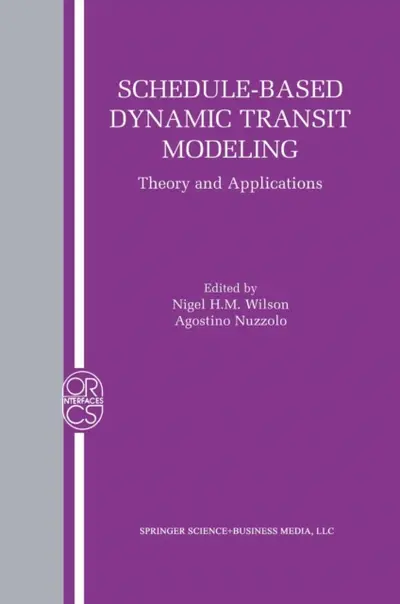
Schedule-Based Dynamic Transit Modeling
Theory and Applications
Price and availability
$120.99
Available in: Andorra, Austria, Australia, Belgium, Bulgaria, Canada, Switzerland, Cyprus, Czechia, Germany, Denmark, Estonia, Spain, Finland, France, United Kingdom, Guernsey, Greece, Croatia, Hungary, Ireland, Isle of Man, Iceland, Italy, Jersey, Japan, Liechtenstein, Lithuania, Luxembourg, Latvia, Monaco, Malta, Netherlands, Norway, Poland, Portugal, Romania, Sweden, Slovenia, Slovakia, San Marino, United States, Vatican City, South Africa
Stores: US, UK, Canada, EU, Australia.
Sign in to buyThe price is re-checked by the server before payment.
For personal use under the eBook licence.
- Format
- DRM
- Not stated by the publisher
- Language
- English
- Publisher
- Springer US
- Published
- 9 March 2013
- ISBN
- 9781475764673
- Subjects
- Cybernetics & systems theory, Economics, Urban economics, Operational research, Industry & industrial studies, Transport planning & policy, Engineering: general, Civil engineering, surveying & building, Transport technology & trades, Cybernetics and systems theory, Regional / International studies, Economics of industrial organization, Political economy, Management decision making, Operational research, Maths for engineers, Civil engineering, surveying and building
About this book
Schedule-Based Dynamic Transit Modeling: Theory and Applications outlines the new schedule-based dynamic approach to mass transit modeling. In the last ten years the schedule-based dynamic approach has been developed and applied especially for operational planning. It allows time evolution of on-board loads and travel times for each run of each line to be obtained, and uses behavioral hypotheses strictly related to transit systems and user characteristics. It allows us to open new frontiers in transit modelling to support network design, timetable setting, investigation of congestion effects, as well as the assessment of new technologies introduction, such as information to users (ITS technologies). The contributors and editors of the book are leading researchers in the field of transportation, and in this volume they build a solid foundation for developing still more sophisticated models. These future models of mass transit systems will continue to add higher levels of accuracy and sensitivity desired in forecasting the performance of public transport systems.
Bibliographic data © Gardners Books Ltd.