PDF · English
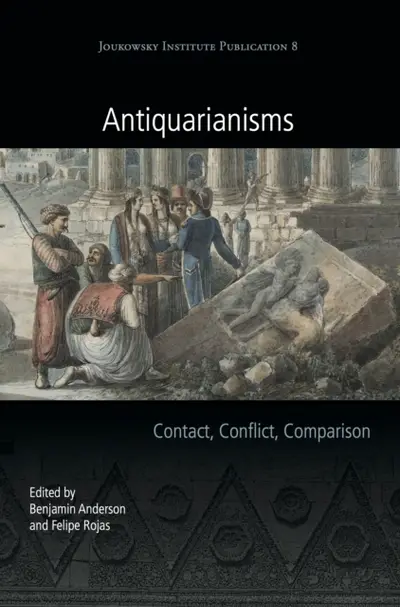
Antiquarianisms
Contact, Conflict, Comparison
Price and availability
$28.99
Available in: Andorra, Austria, Australia, Belgium, Bulgaria, Canada, Switzerland, Cyprus, Czechia, Germany, Denmark, Estonia, Spain, Finland, France, United Kingdom, Guernsey, Greece, Croatia, Hungary, Ireland, Isle of Man, Iceland, Italy, Jersey, Japan, Liechtenstein, Lithuania, Luxembourg, Latvia, Monaco, Malta, Netherlands, Norway, Poland, Portugal, Romania, Sweden, Slovenia, Slovakia, San Marino, United States, Vatican City, South Africa
Stores: US, UK, Canada, EU, Australia.
Sign in to buyThe price is re-checked by the server before payment.
For personal use under the eBook licence.
- Format
- DRM
- Not stated by the publisher
- Language
- English
- Publisher
- Oxbow Books
- Published
- 31 May 2017
- Pages
- 232
- ISBN
- 9781785706875
- Subjects
- USA, Mediterranean countries, Archaeology, Archaeology by period / region, Social & cultural anthropology, ethnography, United States of America, USA, Mediterranean countries / Mediterranean basin, Social and cultural anthropology, NK, NKD
About this book
Antiquarianism and collecting have been associated intimately with European imperial and colonial enterprises, although both existed long before the early modern period and both were (and continue to be) practiced in places other than Europe. Scholars have made significant progress in the documentation and analysis of indigenous antiquarian traditions, but the clear-cut distinction between “indigenous” and “colonial” archaeologies has obscured the intense and dynamic interaction between these seemingly different endeavours. This book concerns the divide between local and foreign antiquarianisms focusing on case studies drawn primarily from the Mediterranean and the Americas. Both regions host robust pre-modern antiquarian traditions that have continued to develop during periods of colonialism. In both regions, moreover, colonial encounters have been mediated by the antiquarian practices and preferences of European elites. The two regions also exhibit salient differences. For example, Europeans claimed the “antiquities” of the eastern Mediterranean as part of their own, “classical,” heritage, whereas they perceived those of the Americas as essentially alien, even as they attempted to understand them by analogy to the classical world. These basic points of comparison and contrast provide a framework for conjoint analysis of the emergence of hybrid or cross-bred antiquarianisms. Rather than assuming that interest in antiquity is a human universal, this book explores the circumstances under which the past itself is produced and transformed through encounters between antiquarian traditions over common objects of interpretation.
Bibliographic data © Gardners Books Ltd.