EPUB · English
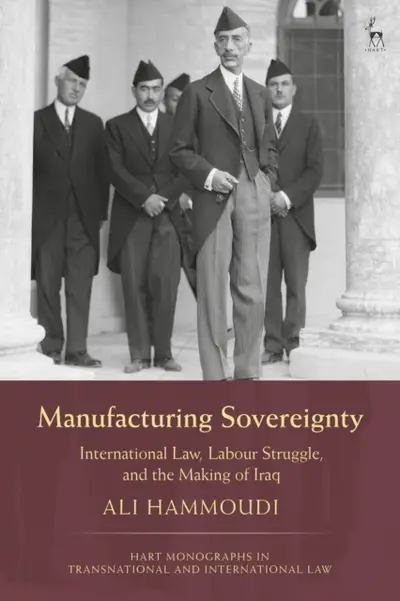
Manufacturing Sovereignty
International Law, Labour Struggle, and the Making of Iraq
Price and availability
$109.99
Available in: Andorra, Austria, Australia, Belgium, Bulgaria, Canada, Switzerland, Cyprus, Czechia, Germany, Denmark, Estonia, Spain, Finland, France, United Kingdom, Guernsey, Greece, Croatia, Hungary, Ireland, Isle of Man, Iceland, Italy, Jersey, Japan, Liechtenstein, Lithuania, Luxembourg, Latvia, Monaco, Malta, Netherlands, Norway, Poland, Portugal, Romania, Sweden, Slovenia, Slovakia, San Marino, United States, Vatican City, South Africa
Stores: US, UK, Canada, EU, Australia.
Sign in to buyThe price is re-checked by the server before payment.
For personal use under the eBook licence.
- Format
- EPUB
- DRM
- Not stated by the publisher
- Language
- English
- Publisher
- Bloomsbury Publishing
- Published
- 19 February 2026
- Pages
- 304
- ISBN
- 9781509952885
- Subjects
- Public international law, Employment & labour law, Public international law, Employment and labour law: general
About this book
This book delves into the legal and labour history of the Hashemite Kingdom of Iraq to explore the role international law and its institutions played in Iraq's state formation.Focusing on a turbulent period in global and Middle East history, it shows how the case of Iraq became a laboratory for experimentation with the concept of sovereignty by the Permanent Mandates Commission of the League of Nations in Geneva. This resulted in the development of a doctrine of 'semiperipheral sovereignty' to justify Iraq's independence from the Mandate process. This novel doctrine and its operation within the provisions of the 1930 Anglo-Iraq Treaty ensured the maintenance of British dominance over Iraq, especially to safeguard the extraction and transportation of its valuable oil resources to Western markets.The book traces how this legal doctrine impacted the everyday lives of working class Iraqis. It explores the governance of the extraterritorial spaces of capitalist accumulation and labour exploitation, in particular the Iraq Petroleum Company oil fields, the Iraq State Railways and the Port of Basra. It goes on to detail how the oil, railway and port workers led by the Iraqi Communist Party effectively organised themselves into a nationalist revolutionary labour movement. They waged an anti-colonial struggle against these imperial legal structures to improve their lot, leading up to the 1948 Wathba, the 1953 Intifada, and ultimately the July Revolution of 1958, which upended the British-sponsored monarchy.Spanning various international archives and Arabic primary source materials, this book offers an example of a social, legal and labour history written from below, centering ordinary working peoples' agency in the historiography of international law. Drawing on Third World Approaches to International Law (TWAIL) and Marxist methodologies, it emphasises the significance of the semi-periphery in the making of the international legal order.
Bibliographic data © Gardners Books Ltd.