PDF · English
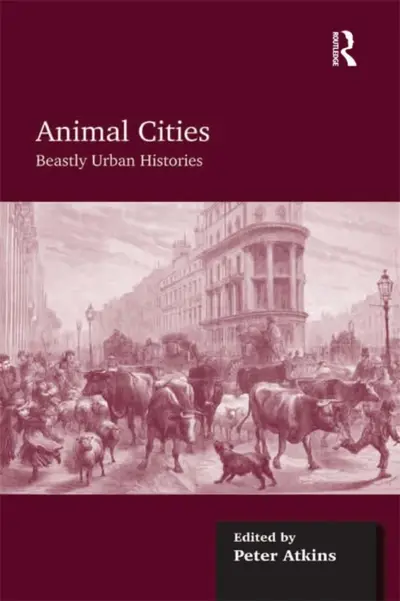
Animal Cities
Beastly Urban Histories
Price and availability
$78.99
Available in: Andorra, Austria, Australia, Belgium, Bulgaria, Canada, Switzerland, Cyprus, Czechia, Germany, Denmark, Estonia, Spain, Finland, France, United Kingdom, Guernsey, Greece, Croatia, Hungary, Ireland, Isle of Man, Iceland, Italy, Jersey, Japan, Liechtenstein, Lithuania, Luxembourg, Latvia, Monaco, Malta, Netherlands, Norway, Poland, Portugal, Romania, Sweden, Slovenia, Slovakia, San Marino, United States, Vatican City, South Africa
Stores: US, UK, Canada, EU, Australia.
Sign in to buyThe price is re-checked by the server before payment.
For personal use under the eBook licence.
- Format
- DRM
- Not stated by the publisher
- Language
- English
- Publisher
- Taylor & Francis
- Published
- 15 April 2016
- ISBN
- 9781317180852
- Subjects
- Industrialisation & industrial history, Ethics & moral philosophy, Animals & society, Sociology, Geography, Human geography, Regional & area planning, Paris (city), London, Greater London, Edinburgh, Cultural studies, Social and cultural history, Urban and municipal planning and policy
About this book
Animal Cities builds upon a recent surge of interest about animals in the urban context. Considering animals in urban settings is now a firmly established area of study and this book presents a number of valuable case studies that illustrate some of the perspectives that may be adopted. Having an 'urban history' flavour, the book follows a fourfold agenda. First, the opening chapters look at working and productive animals that lived and died in nineteenth-century cities such as London, Edinburgh and Paris. The argument here is that their presence yields insights into evolving understandings of the category 'urban' and what made a good city. Second, there is a consideration of nineteenth-century animal spectacles, which influenced contemporary interpretations of the urban experience. Third, the theme of contested animal spaces in the city is explored further with regard to backyard chickens in suburban Australia. Finally, there is discussion of the problem of the public companion animal and its role in changing attitudes to public space, illustrated with a chapter on dog-walking in Victorian and Edwardian London. Animal Cities makes a significant contribution to animal studies and is of interest to historical geographers, urban, cultural, social and economic historians and historians of policy and planning.
Bibliographic data © Gardners Books Ltd.