PDF · English
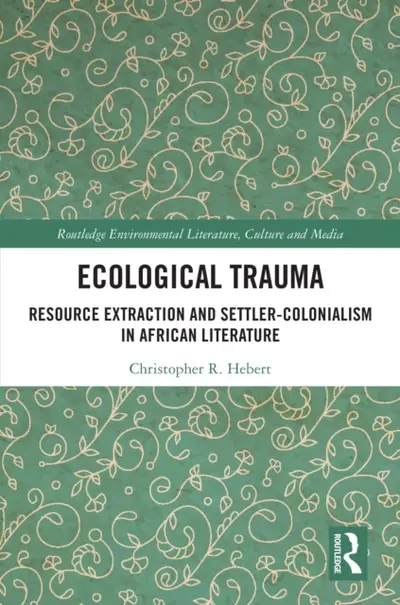
Ecological Trauma
Resource Extraction and Settler-Colonialism in African Literature
- History
- Literary studies & poetry
- Society & social sciences
- Nature, environment & geography
- Medicine & health
Price and availability
$64.99
Available in: Andorra, Austria, Australia, Belgium, Bulgaria, Canada, Switzerland, Cyprus, Czechia, Germany, Denmark, Estonia, Spain, Finland, France, United Kingdom, Guernsey, Greece, Croatia, Hungary, Ireland, Isle of Man, Iceland, Italy, Jersey, Japan, Liechtenstein, Lithuania, Luxembourg, Latvia, Monaco, Malta, Netherlands, Norway, Poland, Portugal, Romania, Sweden, Slovenia, Slovakia, San Marino, United States, Vatican City, South Africa
Stores: US, UK, Canada, EU, Australia.
Sign in to buyThe price is re-checked by the server before payment.
For personal use under the eBook licence.
- Format
- DRM
- Not stated by the publisher
- Language
- English
- Publisher
- Taylor & Francis
- Published
- 11 August 2026
- ISBN
- 9781040564714
- Subjects
- Africa, Literary studies: from c 1900 -, Colonialism & imperialism, Feminism & feminist theory, Ethnic studies, Psychotherapy, Trauma & shock, The environment, Literary theory, Literary studies: fiction, novelists and prose writers, Climate change
About this book
Intervening in debates across literary trauma theory and ecocriticism, this book argues that in an age increasingly defined by the impacts of anthropogenic climate change on society and ecology, it is necessary to graft the ethical concerns of trauma studies onto the lessons of ecocriticism, especially in the context of African literatures.Drawing upon a corpus of African literary texts ranging temporally from 1950 to 2021 and geographically from Nigeria and Cameroon to South Africa, Botswana, Zambia, and Zimbabwe, this book examines how ecological trauma is bound up in human systems of exchange, extraction, and domination. Each text portrays ecological trauma from a different geographical and historical perspective, but they all underscore the wide-ranging ecological and human costs of resource extraction and settler-colonialism across the African continent. Ultimately, this book explores the connections between human and nonhuman communities victimized by anthropogenic climate change and dissects the difficult relationships between land, ecology, and human influence.This book will be of interest to scholars and graduate students working in the fields of African literatures, the environmental humanities, trauma studies, and postcolonial studies, as well as all those interested in narrative in the Anthropocene.
Bibliographic data © Gardners Books Ltd.