PDF · English
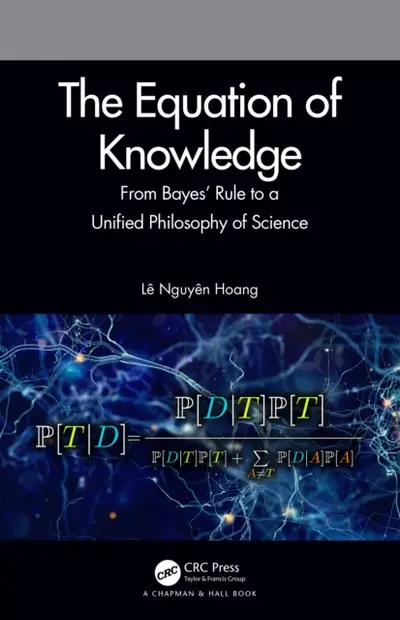
Equation of Knowledge
From Bayes'' Rule to a Unified Philosophy of Science
Price and availability
$44.99
Available in: Andorra, Austria, Australia, Belgium, Bulgaria, Canada, Switzerland, Cyprus, Czechia, Germany, Denmark, Estonia, Spain, Finland, France, United Kingdom, Guernsey, Greece, Croatia, Hungary, Ireland, Isle of Man, Iceland, Italy, Jersey, Japan, Liechtenstein, Lithuania, Luxembourg, Latvia, Monaco, Malta, Netherlands, Norway, Poland, Portugal, Romania, Sweden, Slovenia, Slovakia, San Marino, United States, Vatican City, South Africa
Stores: US, UK, Canada, EU, Australia.
Sign in to buyThe price is re-checked by the server before payment.
For personal use under the eBook licence.
- Format
- DRM
- Not stated by the publisher
- Language
- English
- Publisher
- CRC Press
- Published
- 18 June 2020
- ISBN
- 9781000063233
- Subjects
- Mathematics, Philosophy of mathematics, Mathematical logic, Probability & statistics, History of mathematics, Sudoku & number puzzles, Probability and statistics, Philosophy: epistemology and theory of knowledge, Artificial intelligence (AI)
About this book
The Equation of Knowledge: From Bayes' Rule to a Unified Philosophy of Science introduces readers to the Bayesian approach to science: teasing out the link between probability and knowledge. The author strives to make this book accessible to a very broad audience, suitable for professionals, students, and academics, as well as the enthusiastic amateur scientist/mathematician. This book also shows how Bayesianism sheds new light on nearly all areas of knowledge, from philosophy to mathematics, science and engineering, but also law, politics and everyday decision-making.Bayesian thinking is an important topic for research, which has seen dramatic progress in the recent years, and has a significant role to play in the understanding and development of AI and Machine Learning, among many other things. This book seeks to act as a tool for proselytising the benefits and limits of Bayesianism to a wider public. Features Presents the Bayesian approach as a unifying scientific method for a wide range of topics Suitable for a broad audience, including professionals, students, and academics Provides a more accessible, philosophical introduction to the subject that is offered elsewhere
Bibliographic data © Gardners Books Ltd.