EPUB · English
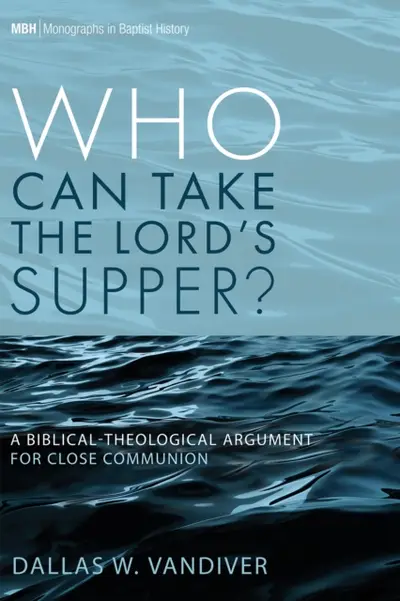
Who Can Take the Lord's Supper?
A Biblical-Theological Argument for Close Communion
Price and availability
$62.99
Available in: Andorra, Austria, Australia, Belgium, Bulgaria, Canada, Switzerland, Cyprus, Czechia, Germany, Denmark, Estonia, Spain, Finland, France, United Kingdom, Guernsey, Greece, Croatia, Hungary, Ireland, Isle of Man, Iceland, Italy, Jersey, Japan, Liechtenstein, Lithuania, Luxembourg, Latvia, Monaco, Malta, Netherlands, Norway, Poland, Portugal, Romania, Sweden, Slovenia, Slovakia, San Marino, United States, Vatican City, South Africa
Stores: US, UK, Canada, EU, Australia.
Sign in to buyThe price is re-checked by the server before payment.
For personal use under the eBook licence.
- Format
- EPUB
- DRM
- Not stated by the publisher
- Language
- English
- Publisher
- Wipf and Stock Publishers
- Published
- 10 September 2021
- ISBN
- 9781666703153
- Subjects
- Baptist Churches, Christian theology, Christian sacraments, Baptist Churches, Christian sacraments
About this book
Baptism and the Lord's Supper are likely more basic for the church than you think. When Jesus inaugurated the new covenant by his death on the cross, he established baptism as the new covenant sign of entry and the Lord's Supper as the new covenant sign of participation. These signs identify believers with Christ and his people. They are integral to the existence, membership, and discipline of the local church. In answer to the question "e;Who can take the Lord's Supper?"e; this book catalogues four major positions in the broad Baptist tradition. While proponents of various views have appealed to the necessity of circumcision for participation in Passover as evidence for their position, none have adequately worked out the covenantal relationships between circumcision and baptism or Passover and the Lord's Supper. By contrast to Reformed pedobaptist covenantal theology and in distinction from Baptist covenantal theology and dispensational theologies, this book develops the relation of these covenantal signs from a progressive-covenantal perspective. It presents an unprecedented comparison of the continuities and discontinuities between the covenant signs across the storyline of Scripture to demonstrate a biblical-theological principle that the sign of entry should precede the sign of participation.
Bibliographic data © Gardners Books Ltd.