PDF · English
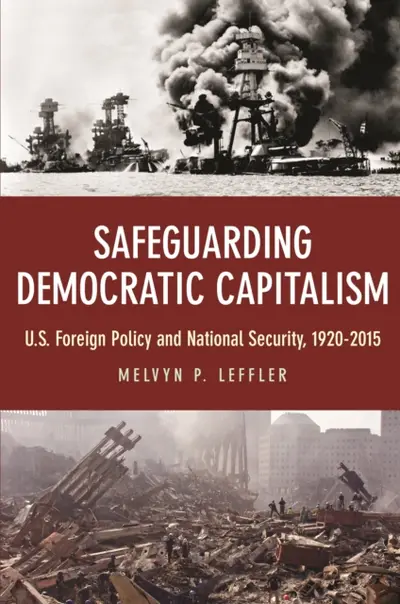
Safeguarding Democratic Capitalism
U.S. Foreign Policy and National Security, 1920-2015
Price and availability
$40.99
Available in: Andorra, Austria, Australia, Belgium, Bulgaria, Canada, Switzerland, Cyprus, Czechia, Germany, Denmark, Estonia, Spain, Finland, France, United Kingdom, Guernsey, Greece, Croatia, Hungary, Ireland, Isle of Man, Iceland, Italy, Jersey, Japan, Liechtenstein, Lithuania, Luxembourg, Latvia, Monaco, Malta, Netherlands, Norway, Poland, Portugal, Romania, Sweden, Slovenia, Slovakia, San Marino, United States, Vatican City, South Africa
Stores: US, UK, Canada, EU, Australia.
Sign in to buyThe price is re-checked by the server before payment.
For personal use under the eBook licence.
- Format
- DRM
- Not stated by the publisher
- Language
- English
- Publisher
- Princeton University Press
- Published
- 2 August 2017
- ISBN
- 9781400888061
- Subjects
- USA, 20th century, 21st century, History of the Americas, Constitution: government & the state, Central government policies, International relations, United States of America, USA, Politics and government, Central / national / federal government policies, International relations, Warfare and defence, History of the Americas
About this book
Safeguarding Democratic Capitalism gathers together decades of writing by Melvyn Leffler, one of the most respected historians of American foreign policy, to address important questions about U.S. national security policy from the end of World War I to the global war on terror. Why did the United States withdraw strategically from Europe after World War I and not after World War II? How did World War II reshape Americans' understanding of their vital interests? What caused the United States to achieve victory in the long Cold War? To what extent did 9/11 transform U.S. national security policy? Is budgetary austerity a fundamental threat to U.S. national interests?Leffler's wide-ranging essays explain how foreign policy evolved into national security policy. He stresses the competing priorities that forced policymakers to make agonizing trade-offs and illuminates the travails of the policymaking process itself. While assessing the course of U.S. national security policy, he also interrogates the evolution of his own scholarship. Over time, slowly and almost unconsciously, Leffler's work has married elements of revisionism with realism to form a unique synthesis that uses threat perception as a lens to understand how and why policymakers reconcile the pressures emanating from external dangers and internal priorities.An account of the development of U.S. national security policy by one of its most influential thinkers, Safeguarding Democratic Capitalism includes a substantial new introduction from the author.
Bibliographic data © Gardners Books Ltd.