EPUB · English
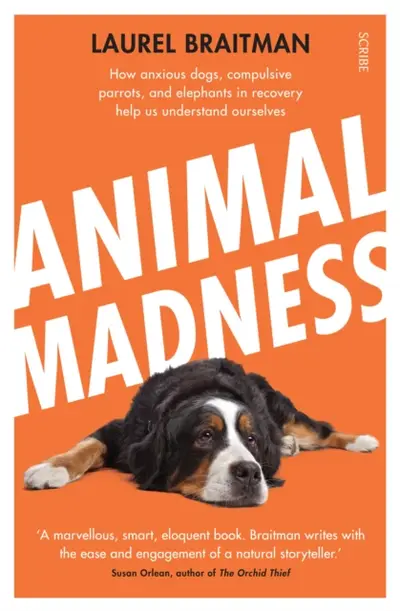
Animal Madness
how anxious dogs, compulsive parrots, and elephants in recovery help us understand ourselves
Price and availability
Not sold in this region
Available in: Australia, United Kingdom, Ireland, Isle of Man, South Africa
Stores: UK, EU (some countries), Australia. Not available in the United States store.
This title cannot be bought in this store yet: its supplier terms, territorial rights or price are still being confirmed.
For personal use under the eBook licence.
- Format
- EPUB
- DRM
- Not stated by the publisher
- Language
- English
- Publisher
- Scribe Publications Pty Ltd
- Published
- 29 September 2014
- Pages
- 384
- ISBN
- 9781925113471
- Subjects
- Psychology, Popular science, Zoology & animal sciences, Animal behaviour, Domestic animals & pets, Animals and society / Animal rights - issues and debates, Zoology and animal sciences, Zoology: birds (ornithology), Zoology: mammals (mammalogy), Zoology: primates (primatology), Wildlife: general interest, Wildlife: mammals: general interest, Wildlife: aquatic creatures: general interest, Domestic animals and pets, Cats as pets, Dogs as pets, Horses and ponies: general interest, Birds, including cage birds, as pets, Rabbits and rodents as pets
About this book
Science historian Laurel Braitman draws on evidence from across the world to show, for the first time, how astonishingly similar humans and other animals are when it comes to their emotional wellbeing.Charles Darwin developed his evolutionary theories by studying Galapagos finches and fancy pigeons; Alfred Russel Wallace investigated creatures in the Malay Archipelago. Laurel Braitman got her lessons closer to home by watching her dog. Oliver snapped at flies that only he could see, suffered from debilitating separation anxiety, was prone to aggression, and may even have attempted suicide. Braitman s experiences with Oliver made her acknowledge a startling connection: non-human animals can lose their minds. And when they do, it often looks a lot like human mental illness.Thankfully, all of us can heal. Braitman spent three years travelling the world in search of emotionally disturbed animals and the people who care for them, finding numerous stories of recovery: parrots that learn how to stop plucking their feathers, dogs that cease licking their tails raw, polar bears that stop swimming in compulsive circles, and great apes that benefit from the help of human psychiatrists. How do these animals recover? The same way we do: with love, medicine, and above all, the knowledge that someone understands why we suffer and what can make us feel better.PRAISE FOR LAUREL BRAITMAN [A] fascinating contribution to studies of animal behaviour The Age Braitman wants us to take animals seriously to see them as individuals with life histories and psychologies as dramatic and intense as our own [She] has an absolute, not a comparative, sense of the animal soul. The New Yorker
Bibliographic data © Gardners Books Ltd.