EPUB · English
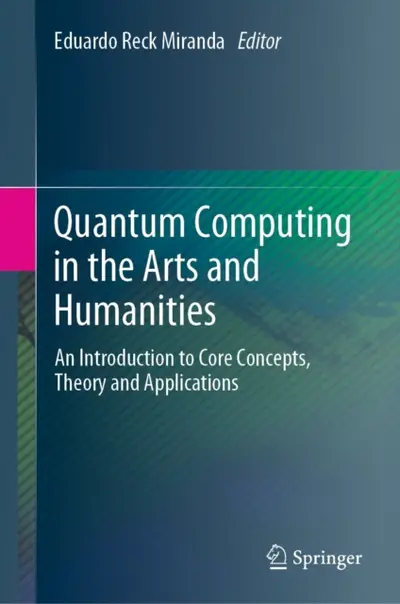
Quantum Computing in the Arts and Humanities
An Introduction to Core Concepts, Theory and Applications
Price and availability
$161.99
Available in: Andorra, Austria, Australia, Belgium, Bulgaria, Canada, Switzerland, Cyprus, Czechia, Germany, Denmark, Estonia, Spain, Finland, France, United Kingdom, Guernsey, Greece, Croatia, Hungary, Ireland, Isle of Man, Iceland, Italy, Jersey, Japan, Liechtenstein, Lithuania, Luxembourg, Latvia, Monaco, Malta, Netherlands, Norway, Poland, Portugal, Romania, Sweden, Slovenia, Slovakia, San Marino, United States, Vatican City, South Africa
Stores: US, UK, Canada, EU, Australia.
Sign in to buyThe price is re-checked by the server before payment.
For personal use under the eBook licence.
- Format
- EPUB
- DRM
- Not stated by the publisher
- Language
- English
- Publisher
- Springer International Publishing
- Published
- 5 May 2022
- ISBN
- 9783030955380
- Subjects
- Computational linguistics, Literature: history & criticism, Philosophy of science, Mathematical theory of computation, Artificial intelligence, Computational and corpus linguistics, Philosophy of science, Quantum physics (quantum mechanics and quantum field theory), Applied computing, Digital Humanities / Computer applications in the arts and humanities, Computer applications in the social and behavioural sciences, Mathematical theory of computation, Artificial intelligence (AI)
About this book
Computers are essential for the functioning of our society. Despite the incredible power of existing computers, computing technology is progressing beyond today's conventional models. Quantum Computing (QC) is surfacing as a promising disruptive technology. QC is built on the principles of quantum mechanics. QC can run algorithms that are not trivial to run on digital computers. QC systems are being developed for the discovery of new materials and drugs and improved methods for encoding information for secure communication over the Internet. Unprecedented new uses for this technology are bound to emerge from ongoing research.The development of conventional digital computing technology for the arts and humanities has been progressing in tandem with the evolution of computers since the 1950s. Today, computers are absolutely essential for the arts and humanities. Therefore, future developments in QC are most likely to impact on the way in which artists will create andperform, and how research in the humanities will be conducted.This book presents a comprehensive collection of chapters by pioneers of emerging interdisciplinary research at the crossroads of quantum computing, and the arts and humanities, from philosophy and social sciences to visual arts and music.Prof. Eduardo Reck Miranda is a composer and a professor in Computer Music at Plymouth University, UK, where he is a director of the Interdisciplinary Centre for Computer Music Research (ICCMR). His previous publications include the Springer titles Handbook of Artificial Intelligence for Music, Guide to Unconventional Computing for Music, Guide to Brain-Computer Music Interfacing and Guide to Computing for Expressive Music Performance.
Bibliographic data © Gardners Books Ltd.