PDF · English
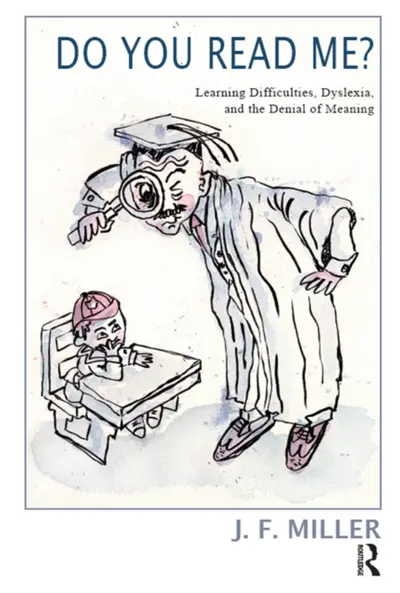
Do You Read Me?
Learning Difficulties, Dyslexia and the Denial of Meaning
Price and availability
$44.99
Available in: Andorra, Austria, Australia, Belgium, Bulgaria, Canada, Switzerland, Cyprus, Czechia, Germany, Denmark, Estonia, Spain, Finland, France, United Kingdom, Guernsey, Greece, Croatia, Hungary, Ireland, Isle of Man, Iceland, Italy, Jersey, Japan, Liechtenstein, Lithuania, Luxembourg, Latvia, Monaco, Malta, Netherlands, Norway, Poland, Portugal, Romania, Sweden, Slovenia, Slovakia, San Marino, United States, Vatican City, South Africa
Stores: US, UK, Canada, EU, Australia.
Sign in to buyThe price is re-checked by the server before payment.
For personal use under the eBook licence.
- Format
- DRM
- Not stated by the publisher
- Language
- English
- Publisher
- Taylor & Francis
- Published
- 11 May 2018
- ISBN
- 9780429898631
- Subjects
- Psychology, Teaching of students with specific learning difficulties / needs, Psychotherapy, Speech & language disorders & therapy, Child care & upbringing, Couple and Family psychology, Educational psychology, Teaching of students with learning difficulties or disorders
About this book
A fascinating and compelling exploration of the learning process for parents, teachers, and anyone with an interest in education. Reading and writing are fundamentally about the communication of meaning. Yet, when a child has difficulty in learning to read and write, the one area that is never seen as having any relevance is the child's life experiences. The author's contention is that the concept of dyslexia is something that has been invented, rather than discovered, in order to evade the question of meaning and the understanding of the individual. Based on the author's thirty years' experience of both educational psychology and analytical therapy, the book sets out a radical approach to learning difficulties in which the primary assumption is that there will usually be underlying emotional conflicts, tensions, and anxieties. Any learning disability is thus more likely to be the symptom of less-evident, personal difficulties, rather than a problem in itself. The book examines, with examples, typical patterns of personal and emotional difficulty that give rise to learning problems.
Bibliographic data © Gardners Books Ltd.