PDF · English
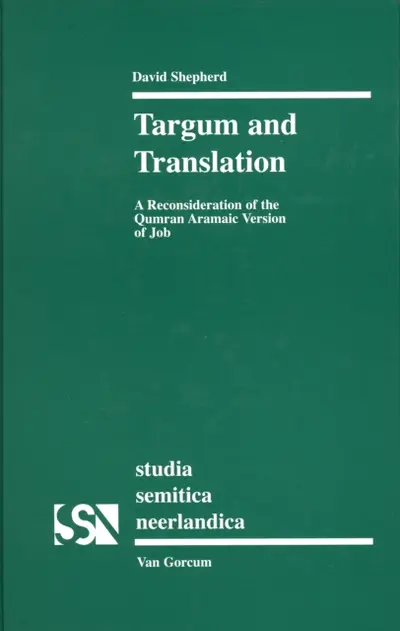
Targum and Translation
A Reconsideration of the Qumran Aramaic Version of Job
Price and availability
$273.99
Available in: Andorra, Austria, Australia, Belgium, Bulgaria, Canada, Switzerland, Cyprus, Czechia, Germany, Denmark, Estonia, Spain, Finland, France, United Kingdom, Guernsey, Greece, Croatia, Hungary, Ireland, Isle of Man, Iceland, Italy, Jersey, Japan, Liechtenstein, Lithuania, Luxembourg, Latvia, Monaco, Malta, Netherlands, Norway, Poland, Portugal, Romania, Sweden, Slovenia, Slovakia, San Marino, United States, Vatican City, South Africa
Stores: US, UK, Canada, EU, Australia.
Sign in to buyThe price is re-checked by the server before payment.
For personal use under the eBook licence.
- Format
- DRM
- Not stated by the publisher
- Language
- English
- Publisher
- Brill
- Published
- 17 July 2018
- ISBN
- 9789004358751
- Subjects
- Language: reference and general, Translation and language interpretation, Judaism: sacred texts and revered writings, Christianity, Criticism and exegesis of sacred texts
About this book
For nearly half a century, the Aramaic version of Job found amongst the scrolls at Qumran has been celebrated as the earliest example of that unique genre of Jewish bible translation known to the Rabbis as targum. In this groundbreaking study, the author challenges this assumption by re-evaluating this significant Qumran text in light of other ancient Aramaic versions of Job, including the Peshitta and Targum. After a fresh review of five decades of research on the Qumran text, the author draws on recent work in the study of the ancient Aramaic versions to chart a new course in its exploration. While both similarities and differences of approach among the respective Aramaic translators are illuminated by a series of examples drawn directly from the texts, the rigorous scrutiny of each version's re-presentation of its source text provides a firm basis for a reassessment of the relationship between the Qumran Aramaic version of Job and its Syriac and Targumic counterparts. By situating the Qumran version within the broader context of other ancient Aramaic versions, the author makes a significant contribution to our understanding of Aramaic idiom and style in the time of the Second Temple. More importantly, however, he offers a radical revision of the Aramaic version of Job's classification and a new and innovative perspective on its place in the panoply of ancient bible versions originating in this crucial period.
Bibliographic data © Gardners Books Ltd.