EPUB · English
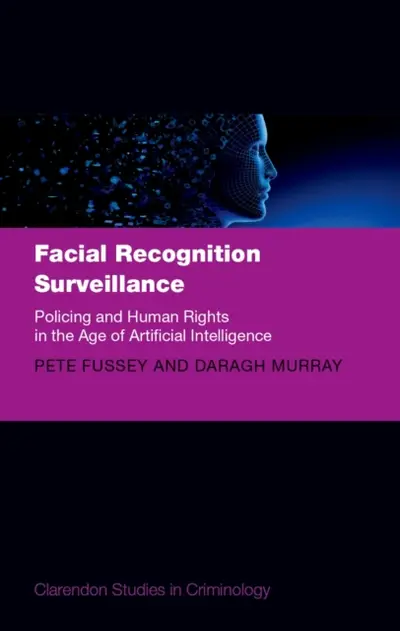
Facial Recognition Surveillance
Policing and Human Rights in the Age of Artificial Intelligence
Price and availability
$94.99
Available in: Andorra, Austria, Australia, Belgium, Bulgaria, Canada, Switzerland, Cyprus, Czechia, Germany, Denmark, Estonia, Spain, Finland, France, United Kingdom, Guernsey, Greece, Croatia, Hungary, Ireland, Isle of Man, Iceland, Italy, Jersey, Japan, Liechtenstein, Lithuania, Luxembourg, Latvia, Monaco, Malta, Netherlands, Norway, Poland, Portugal, Romania, Sweden, Slovenia, Slovakia, San Marino, United States, Vatican City, South Africa
Stores: US, UK, Canada, EU, Australia.
Sign in to buyThe price is re-checked by the server before payment.
For personal use under the eBook licence.
- Format
- EPUB
- DRM
- Not stated by the publisher
- Language
- English
- Publisher
- Oxford University Press
- Published
- 25 June 2025
- ISBN
- 9780192883728
- Subjects
- Police & security services, Criminal investigation & detection, Privacy law, Police law & police procedures, Confidential information law, Criminal investigation and detection, Police law and police procedures, Confidential information law
About this book
Scanning millions of faces each year, facial recognition technology (FRT) has become one of today's fastest growing and most controversial AI-driven surveillance technologies. Based on rare ethnographic access to police FRT deployments, Facial Recognition Surveillance: Policing and Human Rights in the Age of Artificial Intelligence delves into the profound impact of FRT on policing practices, surveillance capabilities, and human rights protections. It reveals how this technology shapes, and is also shaped by, the complex environments in which it is deployed, dramatically reshaping police-citizen interactions. This book exposes the selective scientific and legal narratives that justify the expansion of AI-driven surveillance. It draws on cutting-edge human rights theory to propose a due diligence framework tailored to police use of FRT and introduces the concept of 'compound human rights harm' to capture the multifaceted impact of surveillance. Integrating insights from the sociology of policing, science and technology studies, and human rights scholarship, this book advances a theoretically novel and empirically informed perspective that positions FRT as a socio-technical system capable of altering the fundamental nature of policing.
Bibliographic data © Gardners Books Ltd.