EPUB · English
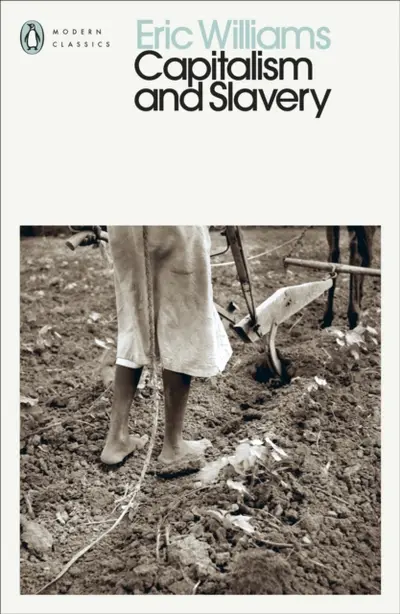
Capitalism and Slavery
Price and availability
Not sold in this region
Available in: Andorra, Austria, Australia, Belgium, Bulgaria, Switzerland, Cyprus, Czechia, Germany, Denmark, Estonia, Spain, Finland, France, United Kingdom, Guernsey, Greece, Croatia, Hungary, Ireland, Isle of Man, Iceland, Italy, Jersey, Japan, Liechtenstein, Lithuania, Luxembourg, Latvia, Monaco, Malta, Netherlands, Norway, Poland, Portugal, Romania, Sweden, Slovenia, Slovakia, San Marino, Vatican City, South Africa
Stores: UK, EU, Australia. Not available in the United States store.
This title cannot be bought in this store yet: its supplier terms, territorial rights or price are still being confirmed.
For personal use under the eBook licence.
- Format
- EPUB
- DRM
- Not stated by the publisher
- Language
- English
- Publisher
- Penguin Books Ltd
- Published
- 24 February 2022
- ISBN
- 9780141999081
- Subjects
- United Kingdom, Great Britain, West Indies, Modern period, c 1500 onwards, British & Irish history, Slavery & abolition of slavery, Social discrimination & inequality, Political science & theory, Economic history, United Kingdom, Great Britain, West Indies, Racism and racial discrimination / Anti-racism, Capitalism, Economic history, European history, Slavery, enslaved persons and abolition of slavery
About this book
'It's often said that books are compulsory reading, but this book really is compulsory. You cannot understand slavery, or British Empire, without it' Sathnam SangheraArguing that the slave trade was at the heart of Britain's economic progress, Eric Williams's landmark 1944 study revealed the connections between capitalism and racism, and has influenced generations of historians ever since.Williams traces the rise and fall of the Atlantic slave trade through the eighteenth and nineteenth centuries to show how it laid the foundations of the Industrial Revolution, and how racism arose as a means of rationalising an economic decision. Most significantly, he showed how slavery was only abolished when it ceased to become financially viable, exploding the myth of emancipation as a mark of Britain's moral progress.'Its thesis is a starting point for a new generation of scholarship' New Yorker
Bibliographic data © Gardners Books Ltd.