EPUB · English
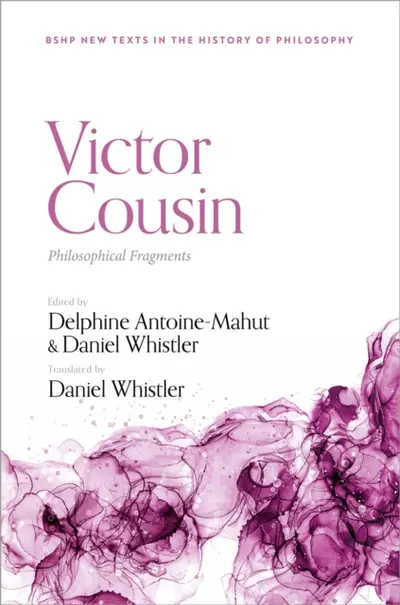
Victor Cousin
Philosophical Fragments
Price and availability
$90.99
Available in: Andorra, Austria, Australia, Belgium, Bulgaria, Canada, Switzerland, Cyprus, Czechia, Germany, Denmark, Estonia, Spain, Finland, France, United Kingdom, Guernsey, Greece, Croatia, Hungary, Ireland, Isle of Man, Iceland, Italy, Jersey, Japan, Liechtenstein, Lithuania, Luxembourg, Latvia, Monaco, Malta, Netherlands, Norway, Poland, Portugal, Romania, Sweden, Slovenia, Slovakia, San Marino, United States, Vatican City, South Africa
Stores: US, UK, Canada, EU, Australia.
Sign in to buyThe price is re-checked by the server before payment.
For personal use under the eBook licence.
- Format
- EPUB
- DRM
- Not stated by the publisher
- Language
- English
- Publisher
- Oxford University Press
- Published
- 3 December 2024
- ISBN
- 9780192636003
- Subjects
- Western philosophy: Enlightenment, Philosophy: metaphysics & ontology, Ethics & moral philosophy, Western philosophy: Enlightenment, Philosophy: metaphysics and ontology, Ethics and moral philosophy
About this book
The first English translation of some of Victor Cousin's most important philosophical writings for over 150 years, accompanied by extensive contextual and analytic resources from a team of internationally recognized Cousin scholars. Victor Cousin was a towering philosophical figure of the nineteenth century: no French philosopher since has fully escaped his shadow. This edition of Philosophical Fragments brings together a series of Cousin's most accessible and significant texts to introduce English-language readers to his thought, along with commentaries on his relationship to Cartesianism, his role in the invention of the historiography of philosophy, as well as his lasting institutional legacy. The edition includes many of Cousin's most significant shorter pieces, such as his 1826 Preface to Philosophical Fragments, the 'manifesto' by means of which he relaunched the French spiritualist project and set out his own eclectic project in the history of philosophy; his 1833 Preface to Philosophical Fragments, in which he responds to mounting criticism of his version of spiritualism by setting out definitively his relations to Descartes, eighteenth-century sensualism, German Idealism, and Catholic theology; and a selection of the Fragments themselves, charting the genesis of his philosophy from the 1810s to the 1840s.
Bibliographic data © Gardners Books Ltd.