PDF · English
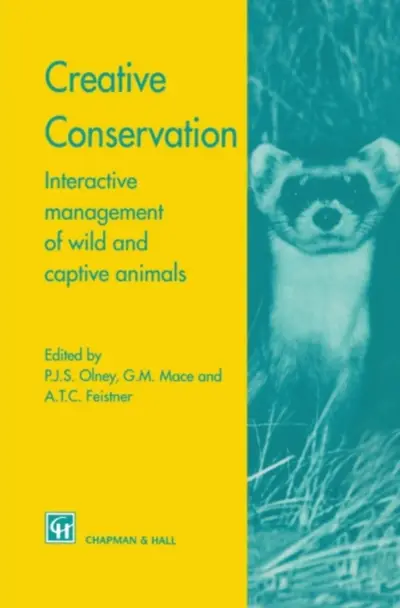
Creative Conservation
Interactive management of wild and captive animals
Price and availability
$337.99
Available in: Andorra, Austria, Australia, Belgium, Bulgaria, Canada, Switzerland, Cyprus, Czechia, Germany, Denmark, Estonia, Spain, Finland, France, United Kingdom, Guernsey, Greece, Croatia, Hungary, Ireland, Isle of Man, Iceland, Italy, Jersey, Japan, Liechtenstein, Lithuania, Luxembourg, Latvia, Monaco, Malta, Netherlands, Norway, Poland, Portugal, Romania, Sweden, Slovenia, Slovakia, San Marino, United States, Vatican City, South Africa
Stores: US, UK, Canada, EU, Australia.
Sign in to buyThe price is re-checked by the server before payment.
For personal use under the eBook licence.
- Format
- DRM
- Not stated by the publisher
- Language
- English
- Publisher
- Springer Netherlands
- Published
- 6 December 2012
- ISBN
- 9789401107211
- Subjects
- Ecological science, the Biosphere, Zoology & animal sciences, Conservation of the environment, Civil engineering, surveying & building, Ecological science, the Biosphere, Zoology and animal sciences, Conservation of the environment, Civil engineering, surveying and building
About this book
Past progress and future challenges R.J. Wheater Royal Zoological Society of Scotland, Edinburgh, UK. In the past two decades much has been achieved in the sphere of breeding endangered species, and we should be pleased that our co- operative efforts have already borne so much fruit. However, on balance and despite the best efforts of conservationists, the position of wildlife in the wild places where they are best conserved has become worse, often dramatically worse. Before returning to the United Kingdom in 1972, I was in Uganda for 16 years, most of which time was spent as Chief Warden of Murchison Falls National Park. Our main problem was that an over-population of large mammals was having a devastating impact on the habitat. Devas- tation was being wrought on woodland areas by the arrival of large numbers of elephants into the sanctuary of the Park, following changes in land use in the areas outside the Park. These changes were in response to the requirements of an ever-expanding human population.
Bibliographic data © Gardners Books Ltd.