PDF · English
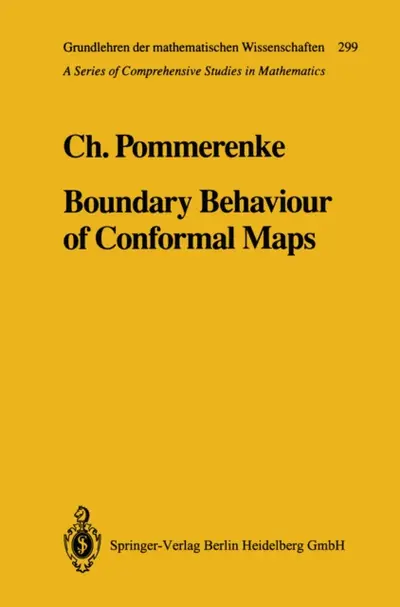
Boundary Behaviour of Conformal Maps
Price and availability
$94.99
Available in: Andorra, Austria, Australia, Belgium, Bulgaria, Canada, Switzerland, Cyprus, Czechia, Germany, Denmark, Estonia, Spain, Finland, France, United Kingdom, Guernsey, Greece, Croatia, Hungary, Ireland, Isle of Man, Iceland, Italy, Jersey, Japan, Liechtenstein, Lithuania, Luxembourg, Latvia, Monaco, Malta, Netherlands, Norway, Poland, Portugal, Romania, Sweden, Slovenia, Slovakia, San Marino, United States, Vatican City, South Africa
Stores: US, UK, Canada, EU, Australia.
Sign in to buyThe price is re-checked by the server before payment.
For personal use under the eBook licence.
- Format
- DRM
- Not stated by the publisher
- Language
- English
- Publisher
- Springer Berlin Heidelberg
- Published
- 9 April 2013
- ISBN
- 9783662027707
- Subjects
- Complex analysis, complex variables, Complex analysis, complex variables, Scientific standards, measurement etc
About this book
We study the boundary behaviour of a conformal map of the unit disk onto an arbitrary simply connected plane domain. A principal aim of the theory is to obtain a one-to-one correspondence between analytic properties of the function and geometrie properties of the domain. In the classical applications of conformal mapping, the domain is bounded by a piecewise smooth curve. In many recent applications however, the domain has a very bad boundary. It may have nowhere a tangent as is the case for Julia sets. Then the conformal map has many unexpected properties, for instance almost all the boundary is mapped onto almost nothing and vice versa. The book is meant for two groups of users. (1) Graduate students and others who, at various levels, want to learn about conformal mapping. Most sections contain exercises to test the understand- ing. They tend to be fairly simple and only a few contain new material. Pre- requisites are general real and complex analyis including the basic facts about conformal mapping (e.g. AhI66a). (2) Non-experts who want to get an idea of a particular aspect of confor- mal mapping in order to find something useful for their work. Most chapters therefore begin with an overview that states some key results avoiding tech- nicalities. The book is not meant as an exhaustive survey of conformal mapping. Several important aspects had to be omitted, e.g. numerical methods (see e.g.
Bibliographic data © Gardners Books Ltd.