EPUB · English
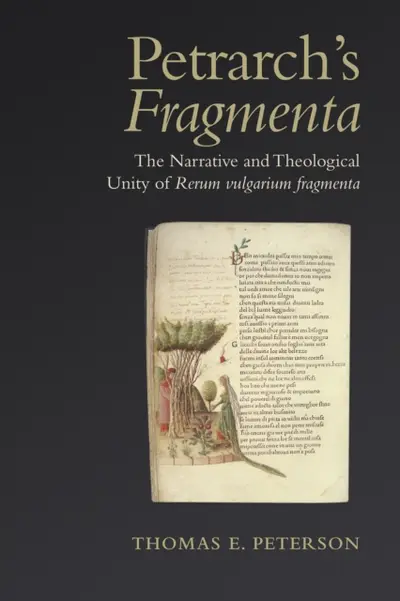
Petrarch's 'Fragmenta'
The Narrative and Theological Unity of ''Rerum vulgarium fragmenta''
Price and availability
$83.99
Available in: Andorra, Austria, Australia, Belgium, Bulgaria, Canada, Switzerland, Cyprus, Czechia, Germany, Denmark, Estonia, Spain, Finland, France, United Kingdom, Guernsey, Greece, Croatia, Hungary, Ireland, Isle of Man, Iceland, Italy, Jersey, Japan, Liechtenstein, Lithuania, Luxembourg, Latvia, Monaco, Malta, Netherlands, Norway, Poland, Portugal, Romania, Sweden, Slovenia, Slovakia, San Marino, United States, Vatican City, South Africa
Stores: US, UK, Canada, EU, Australia.
Sign in to buyThe price is re-checked by the server before payment.
For personal use under the eBook licence.
- Format
- EPUB
- DRM
- Not stated by the publisher
- Language
- English
- Publisher
- University of Toronto Press
- Published
- 16 June 2016
- Pages
- 344
- ISBN
- 9781487510022
- Subjects
- Italy, Sardinia, Sicily, Italian, Literature: history & criticism, Literary studies: general, Literary studies: classical, early & medieval, Literary studies: c 1500 to c 1800, European history, Medieval history, Theology, Italian, Literature: history and criticism, Literary studies: general, Literary studies: ancient, classical and medieval, NH, NHD, QRVG
About this book
Petrarch's Rerum vulgarium fragmenta, a collection of lyric poems on sacred and profane love and other subjects, has traditionally been viewed as reflecting the conflicted nature of its author. However, award winning author Thomas E. Peterson argues that Petrarch’s Fragmenta is an ordered and coherent work unified by narrative and theological structures.By concentrating on the poem’s reliance on Christian tenets and distinguishing between author, narrator and character, Peterson exposes the underlying narrative and theological unity of the work. Building on recent Petrarch scholarship and broader studies of medieval poetics, poetic narrativity, and biblical intertextuality, Peterson conducts a rigorous examination of the Fragmenta’s poetic language. This combination of stylistic and philological analysis recasts Petrarch’s poetry in a new light revealing its radically innovative and liberating character.
Bibliographic data © Gardners Books Ltd.